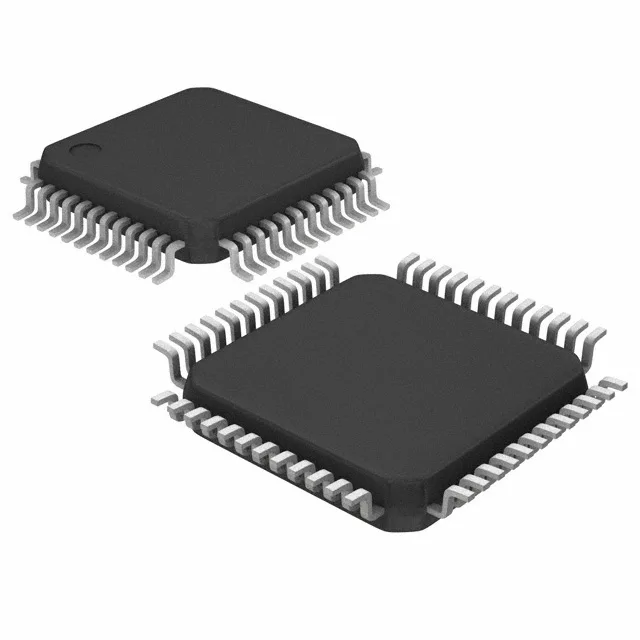
The Infineon CY9AF131KAPMC-G-UNE2 is a 32-bit ARM Cortex-M3 MCU clocked at 20 MHz with 64 KB of Flash and 8 KB of RAM. The 1.8 V to 5.5 V supply range and -40°C to 85°C rating suit industrial environments.
64 KB Flash, 8 KB RAM — sizing the firmware budget
64 KB of program Flash and 8 KB of SRAM fit a single Modbus RTU stack with a PID loop and digital I/O, or a basic sensor-fusion algorithm reading the six 12-bit ADC channels.
20 MHz — why the clock matters for your BOM decision
The 20 MHz core speed is the single biggest differentiator between this part and the faster FM3 siblings. The CY9BF314RPMC-G-JNE2 runs at 144 MHz and carries 103 I/O plus USB — that part is for throughput-heavy applications like a printer controller or a multi-axis motion coordinator. The CY9AF131KAPMC-G-UNE2 at 20 MHz is the right fit when the loop time is in the hundreds of microseconds, not nanoseconds, and the BOM cost per MCU matters more than raw MIPS. If your firmware already runs on a 20 MHz Cortex-M3, this part drops in without retiming the bus.
Peripherals and I/O — what's on the chip
37 I/O lines are brought out to the 48-LQFP package, enough for a keypad matrix, a small character LCD, and a few sensor interrupts. On-chip peripherals include LVD (low-voltage detect), POR (power-on reset), PWM outputs, and a watchdog timer — the basics for a reliable embedded controller without external supervisor ICs. Connectivity covers CSIO, I²C, and UART/USART, so it talks to common serial peripherals and industrial sensor modules directly.
Six 12-bit ADC channels — analog front-end on board
The 6-channel 12-bit ADC handles analog inputs like potentiometer feedback, current-sense resistor voltage, or thermistor dividers. No external ADC needed for a basic control loop — the MCU reads the sensor, runs the PID, and drives the PWM output in one chip. For applications requiring more than six analog inputs or higher resolution, an external multiplexer or a different FM3 variant with more ADC channels would be needed.
It's ROHS3 compliant.