150 MHz Cortex-M4 with 1 MB Flash — processing headroom for sensor fusion and HMI
The CY8C6137BZI-F34 runs a single-core ARM Cortex-M4 at 150 MHz, backed by 1 MB of program flash and 288 KB of SRAM. That memory budget leaves room for a real-time operating system, a touch-sensing stack, and several communication protocol buffers without paging to external memory. An additional 32 KB of on-chip EEPROM handles calibration constants, configuration profiles, and wear-leveled data logging — useful for field-upgradeable firmware that needs to preserve settings across resets.
Supply voltage and temperature grade — single-rail industrial MCU
Not qualified for extended automotive under-hood use (no AEC-Q100 claim in the record).
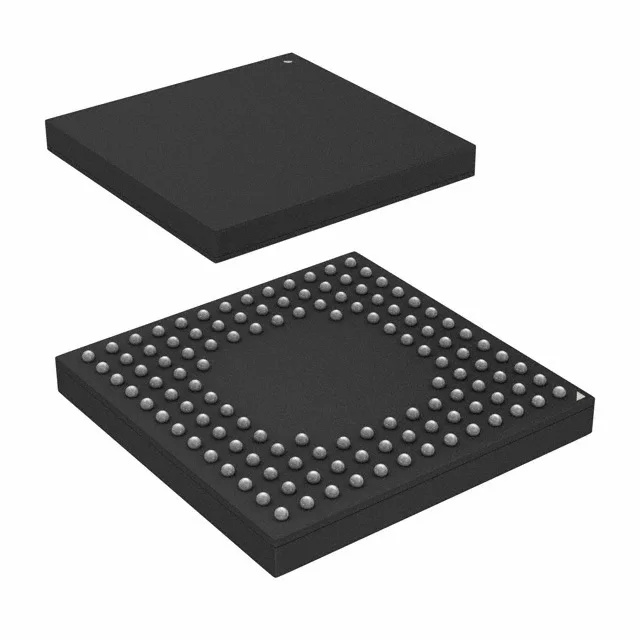
124-ball VFBGA — board integration checklist
Not a hand-solderable package; a reflow oven and stencil printer are assumed. 104 GPIOs are brought out, giving high pin density for parallel buses, multiple UART/I2C/SPI interfaces, and direct touch-sensing electrodes. The remaining 20 balls are power, ground, and no-connects — review the ball-map before committing the layout.
Peripherals and connectivity — CapSense, USB, and analog front-end
Built-in CapSense blocks support capacitive touch buttons, sliders, and proximity sensing without external ICs — a common HMI requirement in white goods, access panels, and industrial keypads. The DMA engine offloads data movement for ADC samples and serial streams. Connectivity includes USB (device/host), QSPI for external flash or RAM, plus I2C, SPI, UART/USART, and LINbus — enough to serve as a sensor hub aggregating multiple fieldbus nodes or as a gateway between a LIN actuator network and a USB host. The 8-channel 12-bit SAR ADC and single 12-bit DAC cover multi-sensor analog acquisition (thermistors, strain gauges, 4-20 mA loops) and one analog output channel without an external converter. The 12-bit resolution is adequate for 0.1% measurement accuracy with proper reference.
No successor or cross-reference is listed; the part is the current shipping variant in the PSoC 6 family. RoHS3 compliant (2011/65/EU + 2015/863), with no exemption-based restrictions. No UL, IEC, or AEC-Q qualification is claimed in the available record — typical for a general-purpose commercial/industrial MCU.