What this PSoC 4 MCU brings to a control or sensor interface design
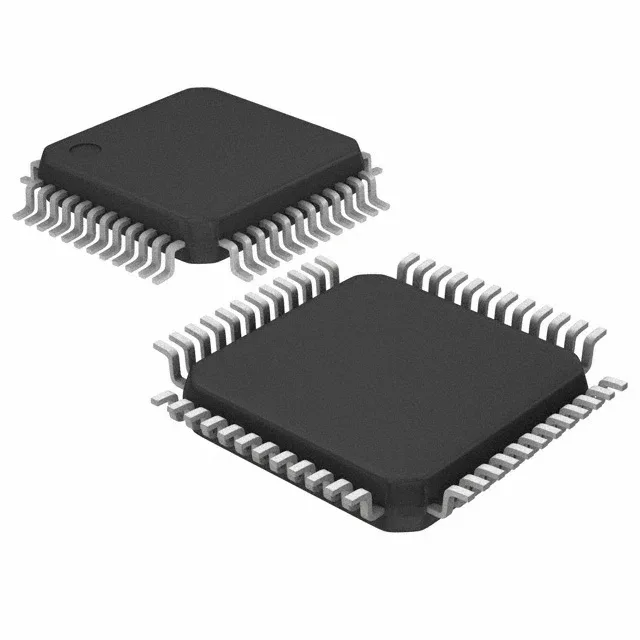
The Infineon CY8C4125AZI-S423 is a 32-bit ARM Cortex-M0+ MCU from the PSoC 4 CY8C4100S series, clocked at 24 MHz with 32 KB Flash and 4 KB RAM. It packs 36 I/O lines, CapSense touch-sensing hardware, LCD segment drive, and a full suite of serial interfaces — I2C, SPI, UART/USART, LINbus, IrDA, Microwire, and SmartCard — in a 48-pin TQFP package. The supply range spans 1.71 V to 5.5 V, letting it bridge 1.8 V and 5 V logic domains without a level shifter. Typical applications include industrial sensor nodes, human-machine interfaces (touch buttons/sliders), appliance control panels, and portable medical devices where the integrated analog and capacitive-sensing blocks reduce external component count.
The ARM Cortex-M0+ core runs at 24 MHz, which is adequate for sensor polling, capacitive-touch scanning, and low-speed motor or valve control. It won't handle heavy DSP or high-speed data logging, but for a dedicated control or interface MCU the speed is well matched to the Flash and RAM sizes.
Memory budget: 32 KB Flash, 4 KB RAM
With 32 KB of Flash and 4 KB of RAM, this part targets firmware images under 20 KB and modest data buffers. The Flash is sufficient for a CapSense library, a communication stack (e.g., I2C slave or UART protocol), and application code — but leaves little room for over-the-air update staging or large lookup tables. The 4 KB RAM handles a few dozen sensor readings and a small frame buffer; designs needing larger packet buffers or extensive state machines should consider the higher-density siblings in the PSoC 4 family.
The 1.71 V to 5.5 V supply range means it can run from a single Li-ion cell (through a regulator) or directly off a 5 V industrial rail. Brown-out detect, POR, and LVD are built in, so external supervisor ICs are unnecessary for basic power monitoring.