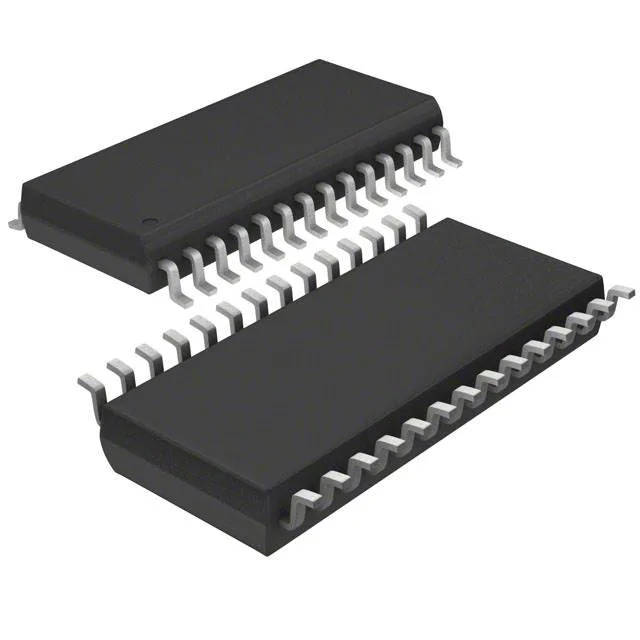
With 16 KB of program Flash and 4 KB of SRAM, this part targets control loops, protocol bridges, and sensor conditioning — not data logging or GUI rendering. The 4 KB SRAM is sufficient for a couple of UART buffers and a modest state machine. If your firmware image is pushing past 12 KB, check whether the 16 KB ceiling leaves room for a field-update staging area. The 4K x 8 SRAM is organized as a single block, so heap fragmentation is something to budget for early.
Programmable analog: 8-channel 12-bit SAR ADC and dual IDACs
The 8-channel 12-bit SAR ADC runs at up to 1 Msps (typical) and can be sequenced autonomously, freeing the CPU for other tasks. Two current-mode IDACs are available for sensor excitation or closed-loop control. This analog front-end is what distinguishes the PSOC 4 from a plain Cortex-M0 — it replaces a separate ADC or DAC on the BOM for many industrial and consumer sensing applications.
For production programs that need multi-year supply assurance, the CY8C4124PVI-432 is a stable choice. The PSOC 4 family has broad adoption, so allocation risk is lower than on niche or sole-sourced MCUs.
28-pin SSOP — footprint and reflow considerations
It is compatible with conventional reflow profiles (MSL 3 per IPC/JEDEC). No exposed pad — thermal dissipation is through the leads, so keep the ambient below 85°C for continuous operation near the maximum current draw. The 24 I/O lines are 5 V tolerant on most pins, simplifying level translation when interfacing to 5 V logic or sensors.