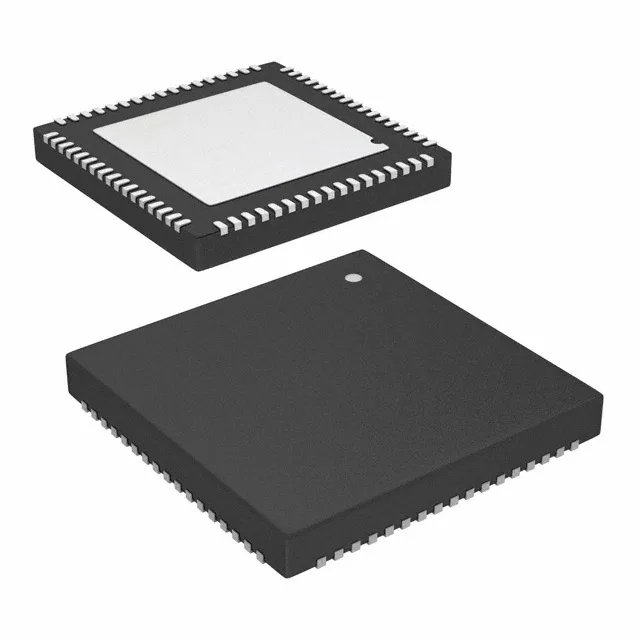
What this PSoC 3 brings to the board
It is a mixed-signal controller — the headline feature is the integrated CapSense block for touch-sensing, plus a 12-bit ADC array (16 channels) and four 8-bit DACs, all on a single die. The 1.71V to 5.5V supply range means you can power it straight from a Li-ion cell or a 5V industrial rail without an extra regulator, which simplifies the power tree on a space-constrained board.
67 MHz 8051 — what that means for throughput
At 67 MHz, this 8051 core is roughly on par with a mid-range ARM Cortex-M0 in integer math, but the real advantage is the programmable analog and digital blocks. The 12-bit ADC can sample at rates suitable for audio or sensor acquisition while the CPU handles USB traffic and CapSense scanning. If you are coming from a slower 8-bit part, budget for the flash wait state — the PSoC 3's flash accelerator needs a single wait state above about 24 MHz, so the 67 MHz figure is achievable with the right clock configuration.
CapSense, USB, and the peripheral set
This part is built for human-interface and control applications. The CapSense block handles capacitive touch buttons, sliders, and proximity sensing without an external controller — a common choice for appliance front panels, medical keypads, and industrial HMIs. USB connectivity (full-speed, likely) lets it talk directly to a host for configuration or data logging. The DMA engine offloads data movement between the ADC, USB, and memory, which keeps the CPU free for higher-level tasks.
The 68-VFQFN with exposed pad (8x8 mm) is a compact, low-inductance package, but it is not a field-swap-friendly part — you will need a hot-air station or a reflow oven to replace it. Without that, the junction temperature climbs quickly above 400 mA continuous I/O load.
It is at home in factory automation panels, outdoor telecom cabinets, automotive cabin modules (non-safety), and any environment where the board sees seasonal temperature swings but not engine-bay extremes. The internal oscillator (no external crystal needed for basic operation) saves a component, though for accurate USB timing you will still want an external resonator or crystal.