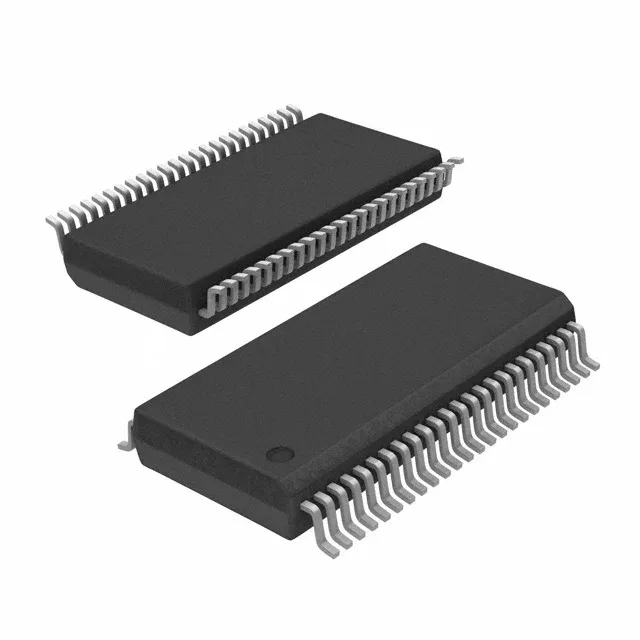
8051 core at 50 MHz with PSoC 3 programmable analog
The CY8C3246PVI-122 is an 8-bit MCU from Cypress's PSoC 3 family, built around an 8051 core clocked at 50 MHz.
CapSense and LCD drive — what they save on the BOM
The integrated CapSense peripheral eliminates a dedicated touch-controller IC for capacitive touch buttons or sliders, and the LCD drive can directly bias a segment LCD panel without an external display driver. For a human-machine interface panel, this consolidation saves one or two ICs, the associated passives, and the board area those components occupy. The 25 I/O lines, routed through the 48-pin SSOP package, provide enough headroom for a keypad matrix, a few sensors, and a UART or I²C link to a host processor.
50 MHz — what the speed buys in a control loop
At 50 MHz the 8051 pipeline executes most instructions in 1–4 clock cycles, yielding roughly 12–25 MIPS of sustained throughput. That is enough for closed-loop PID control at a few kilohertz, real-time CapSense scanning, and a serial protocol like SPI or UART running at a few megabits per second without a dedicated DMA channel — though the DMA is there if you need to move ADC results to RAM without CPU intervention. If your application needs floating-point math or heavy signal processing, the 8051 core will feel the strain; the PSoC 3's digital blocks (PWM, counter, timer) offload periodic tasks efficiently.
The PSoC 4 parts (CY8C4245LQI-483, CY8C4247LQI-BL473) use an ARM Cortex-M0 core at 48 MHz and a different pinout — they require a board spin and firmware port. No direct pin-compatible second source exists in the PSoC family; the CY8C3246PVI-122 is the only 48-SSOP variant at this density and speed grade.