Async FIFO in a 32-PLCC J-lead — what the 10 ns access means for your bus
The CY7C433-10JXC is a 36 Kbit (4 K x 9) asynchronous FIFO from the Cypress CY7C series, now part of the Infineon portfolio. It handles a 50 MHz data rate with a 10 ns access time — the time from read-enable assertion to valid data on the bus. At 50 MHz the cycle period is 20 ns, so the 10 ns access leaves a 10 ns window for the data to settle into the receiving latch before the next clock edge; that margin shrinks if the board trace length or load capacitance adds propagation delay.
Infineon lists the CY7C433-10JXC as obsolete.
Supply rails, temperature grade, and package fit
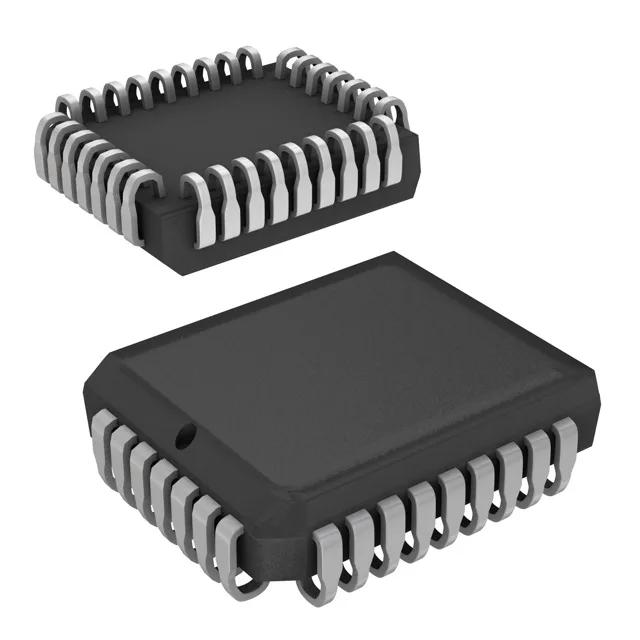
The commercial temperature range (0°C to 70°C) limits it to indoor, non-condensing environments — no automotive or extended industrial use. The 32-PLCC J-lead package (11.43 x 13.97 mm body) is a surface-mount footprint with J-bend leads on a 1.27 mm pitch; the J-lead profile gives a lower seated height than a SOIC but requires a solder-paste stencil aperture sized for the lead geometry. The PLCC socket option exists for prototyping but adds height.
Functional features: retransmit, no flags, uni-directional
This is a first-in-first-out buffer with retransmit capability — the read pointer can be reset to the last programmed retransmit boundary without clearing the entire FIFO, useful for packet retry in a data pipeline. It is uni-directional (separate read and write ports), asynchronous (no external clock needed for the handshake), and expandable in both depth and width by cascading multiple devices. There is no first-word fall-through (FWFT) support and no programmable flag outputs — the only status flags are the standard empty/full pins.