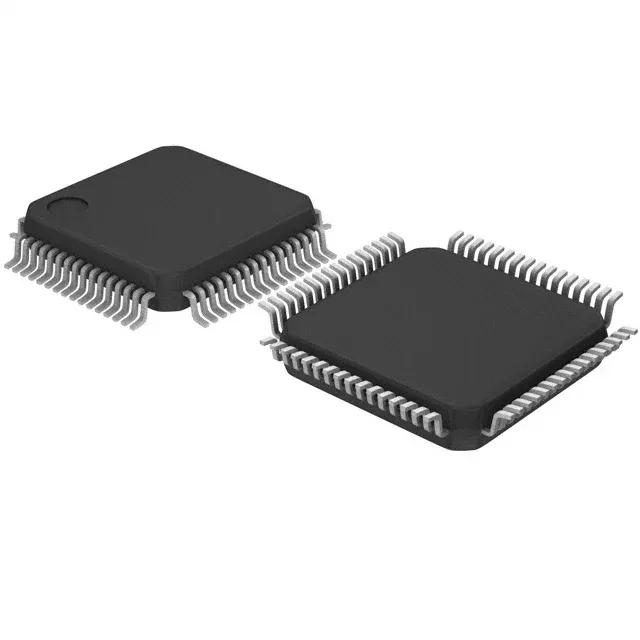
100 MHz synchronous FIFO for 5 V data-path buffering
The Infineon CY7C4205-10AXCT is a synchronous FIFO from the CY7C series, organized as 256 words by 18 bits for a total memory size of 4.5K. The 64-LQFP package (supplier device package 64-TQFP 14x14) mounts on the board surface. This is a 5 V-logic part intended for commercial-temperature environments (0°C to 70°C) — think telecom line cards, printer buffers, or industrial controller data queues where a synchronous FIFO manages rate-matching between a fast source and a slower sink.
8 ns access time and 100 MHz clock — timing budget for the bus
At 100 MHz the clock period is 10 ns, so the access time consumes 80% of the cycle — leaving 2 ns for setup and hold at the receiving device. That is tight but workable with a 5 V-logic family that has fast edge rates; the designer should budget trace delay and any fan-out derating. The 100 MHz data rate means the FIFO can sustain a 100 million word-per-second write or read stream, assuming the bus-directional (uni-directional) flow matches the application.
256 x 18 organization — matching the data path width
The 18-bit word width (256 x 18) suits applications that carry a 16-bit data bus plus two control or parity bits. The depth of 256 words provides a modest buffer — enough to absorb burst disparities in a typical PCI or local-bus interface, but not deep enough for large packet FIFO applications. Expansion is supported in both depth and width, so multiple devices can be cascaded to build larger buffers. Programmable flags (almost-full, almost-empty) let the system set threshold interrupts at configurable levels, reducing polling overhead. Retransmit capability is present, allowing the FIFO to replay data from the last reset of the read pointer — useful in protocol retry schemes.
No FWFT — read-cycle initiation matters
This FIFO does not support First-Word Fall-Through (FWFT). In standard synchronous FIFO operation, the first word written does not appear on the output bus until a read cycle is asserted. FWFT variants present the first word automatically, saving one read cycle on the initial access. If your controller expects FWFT behavior, the CY7C4205-10AXCT requires an extra read pulse to prime the output register. Check your FPGA or ASIC FIFO controller — many can be configured for standard mode, but a mismatch adds a dead cycle on every burst start.