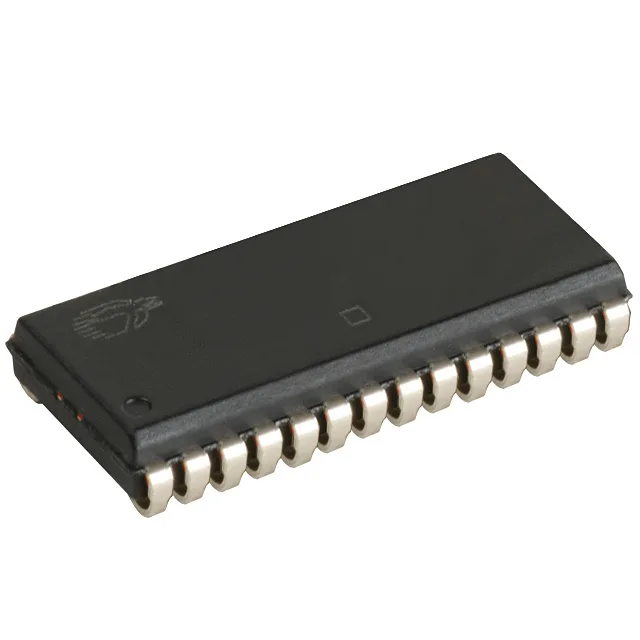
256Kbit asynchronous SRAM with 15 ns access — a legacy 5V workhorse now obsolete
This is a legacy 5V-only memory part, typically found in older microprocessor systems, telecom line cards, and industrial controllers that still run on 5V logic rails and need fast, simple SRAM without the complexity of synchronous clocking.
15 ns access — bus timing margin for legacy CPUs
For a CPU running at 33 MHz (30 ns cycle) or slower, this part provides enough margin to avoid wait states on a single read cycle. If your system bus runs faster than about 40 MHz, you will need to account for the access time in your timing closure — or look for a faster SRAM. The 15 ns rating is the standard speed grade for this density in the CY7C199 family, and it matches the original timing for many 16-bit and 32-bit embedded processors from the 1990s and early 2000s.
Obsolete — no longer in production
Infineon (formerly Cypress Semiconductor) has marked the CY7C199CL-15VXC as obsolete. This means the part is no longer manufactured and is not available through the authorized distribution channel as a current-production item. Any remaining stock in the supply chain is new-old-stock or surplus inventory. For a production BOM that still requires this exact part number, sourcing will be through independent distributors who can locate and verify inventory from surplus or broker sources. Each lot should be inspected for date-code consistency and marking authenticity, as the gray market for discontinued memory parts carries a higher counterfeit risk.
28-SOJ package — footprint and replacement considerations
The 28-SOJ package (0.300" body, 7.62 mm width) is a JEDEC-standard small-outline J-lead footprint. This is a common form factor for 256Kbit and 1Mbit asynchronous SRAMs from multiple vendors, including ISSI, Alliance Memory, and Renesas. When searching for a pin-compatible replacement, the 28-SOJ footprint is the first constraint to match. The supply voltage and access time are the next critical parameters. Because this part is obsolete, the practical path for a legacy board is to qualify a drop-in replacement from a vendor that still offers an active 5V 28-SOJ asynchronous SRAM with the same pinout and 15 ns speed grade.
5V-only operation — not for mixed-voltage buses
All I/O pins are 5V-tolerant and operate at the supply voltage. This part cannot be used directly on a 3.3V bus without level shifters, and it does not have a separate I/O supply. If your system has migrated to a lower core voltage (e.g., 3.3V or 1.8V) but still uses 5V peripheral logic, you will need to check the input thresholds of the host processor or bridge. For new designs, most current SRAMs in this density range operate at 2.7V to 3.6V or lower, so a 5V-only part is increasingly a legacy constraint.
Because the CY7C199CL-15VXC is obsolete, it is not stocked in the normal production pipeline. Each order is quoted individually based on the lot size, date code, and condition of the material located. For a BOM that requires this exact part, the best approach is to submit an RFQ so the current supply picture can be checked across multiple sources. If the BOM can accept a drop-in replacement, qualifying a current-production alternative from ISSI or Alliance Memory in the same 28-SOJ footprint is a more sustainable long-term solution.