That 25 ns window sets the minimum read-cycle time the CPU must wait when this memory is on the bus — fast enough for most 8-bit and 16-bit microcontrollers running at 10–20 MHz without inserting wait states, but tight for a 40 MHz 8051 or a Z80 derivative clocked above 10 MHz. The parallel interface is straightforward: address, data, chip enable, output enable, write enable — no clock, no burst logic.
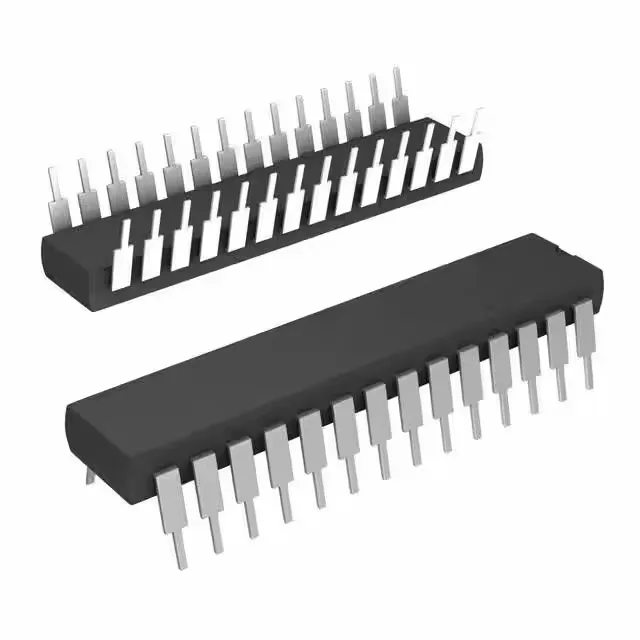
The 28-pin PDIP package is through-hole, so rework and hand-assembly are feasible, but the supply is finite and pricing varies by lot condition. If the design still requires a 5 V asynchronous SRAM in a 28-DIP footprint, a pin-compatible second-source search is the next step; if the board can tolerate a surface-mount package, the SOIC-28 or TSOP-II variants of the same density open up more options.
5 V supply and 0–70 °C — the environment it fits
If the application needs -40 °C to +85 °C, look at the industrial-grade suffix variants of the same base part number.