72Kbit synchronous dual-port SRAM for shared-memory designs
The Cypress CY7C09159AV-12AC is a 72Kbit synchronous dual-port SRAM organized as 8K x 9 bits, designed for systems where two independent controllers or processors need simultaneous access to a shared memory buffer without bus contention. The 12 ns access time and 50 MHz clock rate support back-to-back read/write operations from either port with built-in arbitration logic, making it a fit for telecom line cards, baseband processing, and industrial controller shared-memory blocks where deterministic latency matters.
12 ns access and 50 MHz clock — what they mean for bus timing
The 12 ns access time defines the window from address assertion to valid data on the bus, which sets the setup margin for the receiving controller at the rated 50 MHz clock. In a synchronous dual-port architecture, the 50 MHz clock governs the arbitration handshake — the part resolves simultaneous writes to the same address via a fixed priority scheme, and the clock edge synchronizes the semaphore logic. For a design running a 50 MHz bus, the 12 ns access leaves roughly 8 ns of margin after clock-to-output delay, enough for moderate trace lengths on a standard FR-4 board without signal integrity issues.
8K x 9 organization — why the ninth bit
The 8K x 9 organization includes a ninth bit per word, typically used as a parity bit in telecom or data-communications buffers where single-bit error detection is needed without expanding the word width to 18 bits. The 72Kbit total density suits moderate-size FIFO replacements, mailbox registers, or parameter blocks shared between a DSP and a host microcontroller.
Package and temperature grade — board-fit constraints
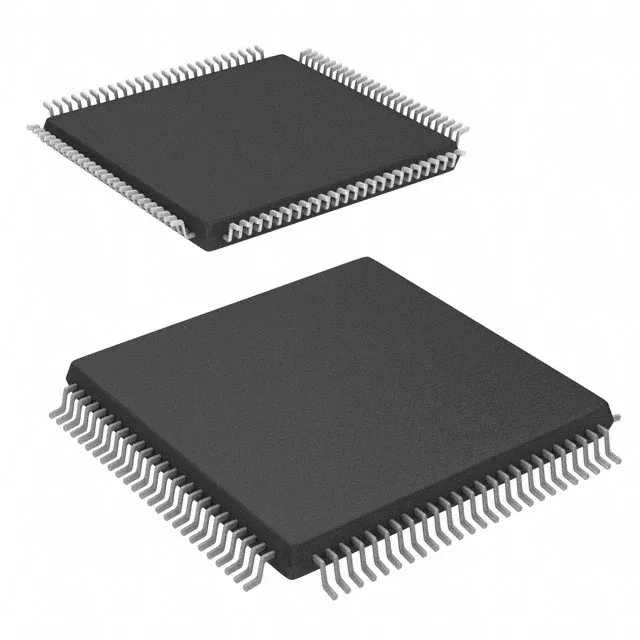
Housed in a 100-TQFP (14x14 mm) package with a 0.5 mm pitch, the footprint is a 14 mm square body with fine-pitch gull-wing leads — standard for manual or reflow assembly, but the 0.5 mm pitch demands careful solder-paste stencil design and alignment.