20 ns dual-port SRAM for shared-memory designs
This part is designed for systems that need two independent processors or controllers to share a common memory block without bus arbitration logic — think dual-processor telecom line cards, video frame buffers, or multiprocessor industrial controllers where each port has its own address, data, and control lines.
That translates to a 50 MHz maximum bus frequency for back-to-back accesses, assuming zero wait states. For a 16-bit microcontroller running at 40 MHz or a DSP with a 50 MHz external memory interface, this part keeps the pipeline fed without inserting wait states. If your processor's memory controller runs faster than 50 MHz, you'll need to budget wait states or step up to a 12 ns or 10 ns dual-port part.
16K x 16 organization — memory map fit
The 16-bit word width matches a 16-bit data bus directly, so you connect the SRAM's data lines straight to the processor's data bus without byte-lane muxing. The 16K depth (32 KB total) is a common size for a shared mailbox or parameter block in dual-processor systems.
For BOM lines that still call out this exact order code, the only channel is the surplus and independent distribution market.
3.3 V supply and industrial temperature
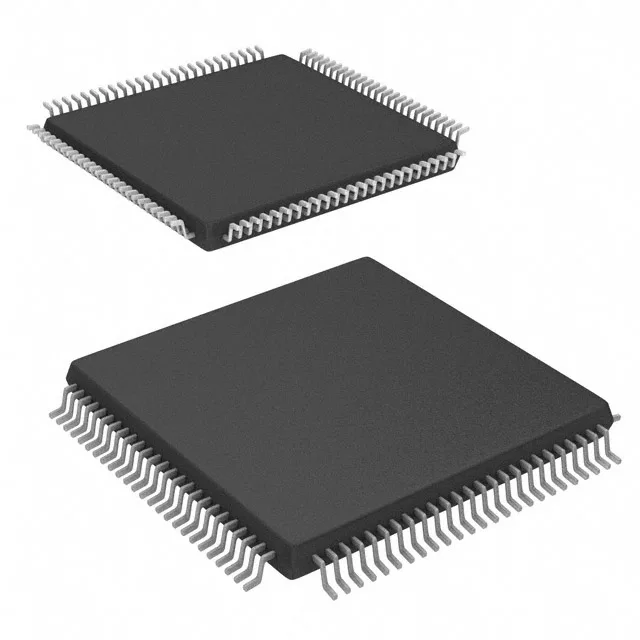
The 3.3 V supply rail (3.0 V to 3.6 V range) makes this part compatible with common low-voltage logic families like LVTTL and 3.3 V CMOS. The 100-LQFP package (14 mm x 14 mm body) is a hand-solderable fine-pitch QFP — a 0.5 mm pitch, so a decent iron and flux will get it down, but a hot-air station or reflow oven is cleaner for production volumes.