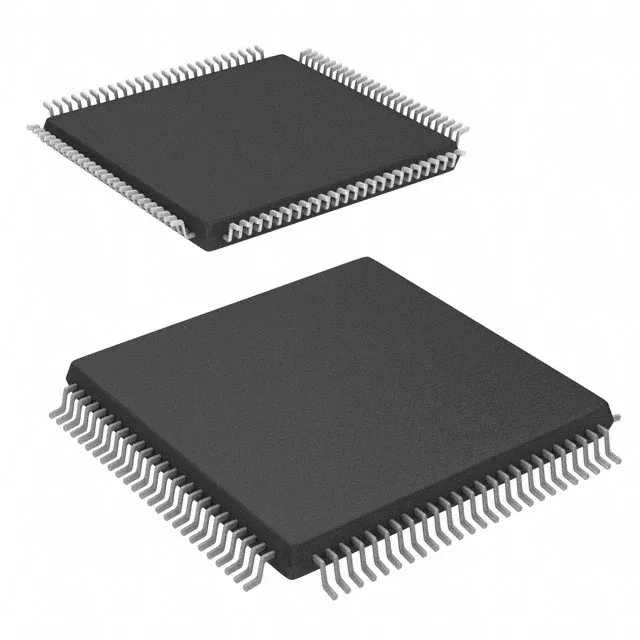
Dual-port SRAM for shared-memory handoff
The Infineon CY7C0241E-25AXCT is a 72Kbit dual-port asynchronous SRAM organized as 4K words by 18 bits. Its two independent ports let two bus masters — say a DSP and an MCU, or two processors — read and write the same memory array without external arbitration logic. The 25 ns access time means each port can complete a read or write cycle within that window, which sets the bus timing budget for the system. This part is the kind of glue memory you see in multiprocessor video cards, network switches, or any design where a shared scratchpad or mailbox buffer avoids a serial link between controllers.
In a dual-port part, both ports share that same timing spec. If your system clock runs at 40 MHz (25 ns period), the memory can just keep pace with a single-cycle access — but you have zero hold margin. At 33 MHz (30 ns period) you get about 5 ns of slack for address decoding, trace delay, and setup. For designs that need to interleave reads and writes from both ports, the arbitration logic inside the chip handles contention on the same address, but it inserts one extra cycle for the winning port. That 25 ns ceiling is the number to budget against your bus timing closure.
5 V supply — legacy bus compatibility
The 5 V rail also means the I/O pins swing to 5 V levels, so check the input tolerance of whatever bus master you connect — many modern MCUs and FPGAs are not 5 V-tolerant on their GPIO.
Infineon (formerly Cypress) has ended production — there is no last-time-buy window open, and no direct factory orders. When quoting, we confirm date codes and condition before committing. There is no official successor part from Infineon for this exact dual-port asynchronous SRAM in this density and speed grade, so a replacement would require a board redesign or a different dual-port memory family.
Package and footprint — 100-TQFP layout notes
The CY7C0241E-25AXCT is supplied in a 100-lead TQFP with a 14x14 mm body and 0.5 mm pitch. For the PCB layout, the 100-TQFP footprint requires a solder-paste stencil aperture around 0.25 x 0.80 mm for the gull-wing leads. Decoupling should follow the standard 0.1 µF ceramic per supply pin pair, placed as close to the package as possible. The 5 V supply rail needs bulk capacitance — at least 10 µF electrolytic or tantalum near the memory — because the dual-port architecture can draw simultaneous current from both ports during back-to-back accesses.