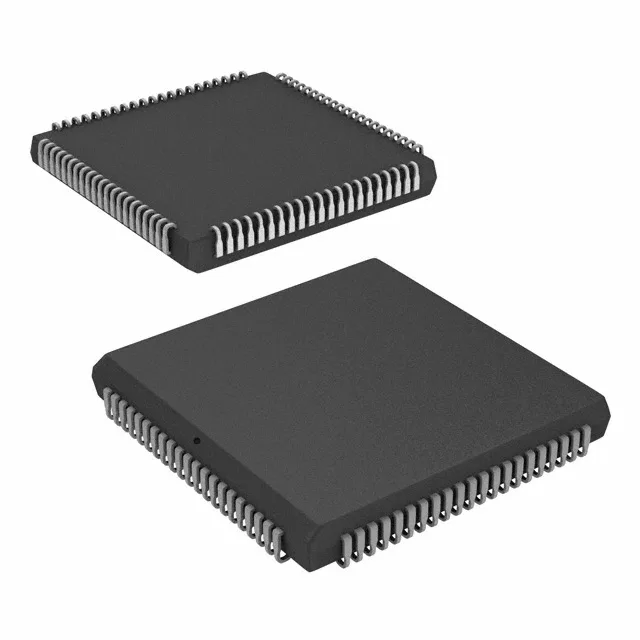
64 Kbit dual-port SRAM — 55 ns asynchronous access
The Cypress CY7C024-55JXCT is a 64 Kbit dual-port asynchronous SRAM organized as 4K words by 16 bits, with a 55 ns access time. This is a volatile memory — data is retained only while power is applied. The dual-port architecture allows two independent systems or processors to read from and write to the same memory array simultaneously, with arbitration logic to resolve access conflicts. Typical applications include shared memory mailboxes, FIFO buffers, and data exchange between DSPs or microcontrollers in telecom, networking, and industrial control equipment where a small, fast inter-processor buffer is needed.
55 ns access time — bus timing budget
In a system with a 20 MHz bus clock (50 ns period), this leaves essentially no margin for address decoding, buffer delays, or signal settling — the part is best matched to slower buses in the 10–12 MHz range or to asynchronous handshake protocols. For designs needing faster throughput, a 25 ns or 15 ns dual-port SRAM would be required, but those are typically in different density or package options.
4K x 16 organization — bus width and addressing
The 4K x 16 organization means 12 address lines and 16 bidirectional data lines. This suits 16-bit microcontrollers, DSPs, or any processor with a 16-bit external data bus. For 8-bit systems, the upper and lower bytes can be accessed separately using the byte-select controls typical of Cypress dual-port SRAMs. The 64 Kbit total is a small buffer — enough for a 4K-word mailbox or a 128-byte packet buffer, not a frame buffer or code store.
The CY7C024-55JXCT is listed as obsolete. Cypress (now part of Infineon) no longer manufactures this device.
84-PLCC J-lead — footprint and rework considerations
The 84-PLCC package with J-leads (29.31 mm x 29.31 mm body) is a surface-mount package that can also be socketed using a PLCC-84 socket. J-leads are less prone to solder bridging than gull-wing leads but are harder to inspect after reflow — X-ray or side-view inspection is recommended. The package is larger than modern equivalents; a 100-pin TQFP or BGA would save board area.
5 V ±10% supply — legacy rail
If the rest of the system runs on lower voltages, level shifters are needed for address, data, and control signals.
If the application sees temperature extremes, the CY7C024-55JI (industrial) variant would be the correct choice — but that is also obsolete and must be sourced from surplus.