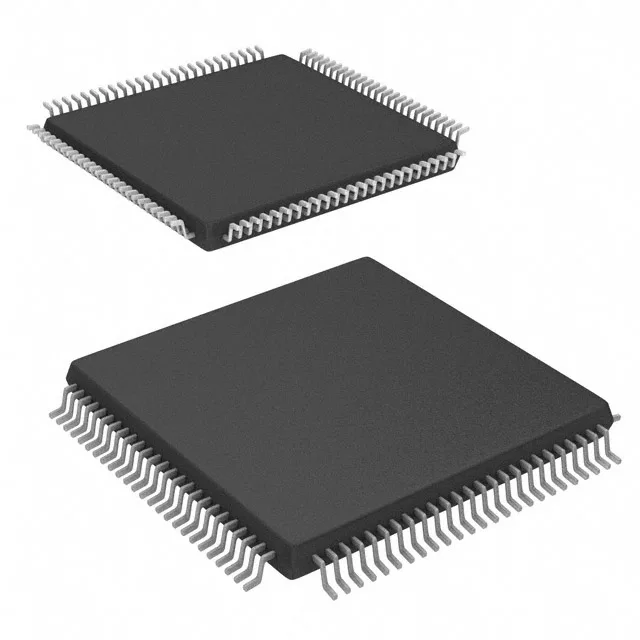
Any remaining stock is what exists in the independent distribution channel — once it's gone, there are no new units coming from the factory. For sustainment programs that already use this dual-port SRAM, the immediate task is to qualify a replacement or secure enough inventory to cover the remaining production run. The 100-TQFP footprint and 5V supply rail narrow the drop-in replacement options considerably.
64Kbit dual-port SRAM with 15 ns access — what it does
The CY7C024-15AXCT is a 64Kbit asynchronous dual-port SRAM organized as 4K words by 16 bits. Dual-port means two independent ports (left and right) can access any memory location simultaneously, with arbitration logic handling collisions. The 15 ns access time allows bus speeds up to roughly 33 MHz in a typical shared-memory application. This class of memory is used as a shared buffer between two processors, a mailbox between an FPGA and a microcontroller, or a FIFO replacement in telecom and networking gear where both sides need random access to the same data set. The parallel interface at both ports keeps latency low — no serialization delay. If your system has moved to 3.3V, you will need a separate 5V supply or a level-translation scheme.
Package and footprint — 100-TQFP (14x14 mm)
The CY7C024-15AXCT comes in a 100-pin TQFP package with a 14x14 mm body and 0.5 mm pitch. This is a standard fine-pitch QFP footprint that reflow solders without special equipment. If you are replacing this part on an existing board, verify that the replacement candidate also comes in a 100-TQFP (14x14) package. Many newer dual-port SRAMs have moved to smaller BGA packages that will not fit the same PCB layout.