Infineon no longer manufactures this dual-port SRAM, so every unit on the market is from inventory or surplus stock. No official successor has been recorded, so a drop-in replacement requires a pin-compatible cross-search.
15 ns access time — the timing floor for bus margin
The 15 ns access time sets the read-cycle window for the dual-port arbitration. At 3.3 V nominal (3V–3.6V supply range,), the part delivers this speed across the commercial temperature range (0°C to 70°C,). If your controller expects a 12 ns or faster SRAM, the CY7C019V-15AC will not meet the setup/hold window — timing closure depends on matching this 15 ns ceiling to the bus cycle budget.
128K x 9 dual-port — shared memory for two bus masters
Organised as 128K x 9, the ninth bit is a dedicated parity lane — useful for data integrity in dual-controller systems such as a DSP talking to a host processor. The asynchronous dual-port interface means each port runs independently on its own clock domain; the write-cycle time matches the read access at 15 ns, so back-to-back writes from one port while the other reads do not stall the bus.
100-TQFP footprint — layout considerations
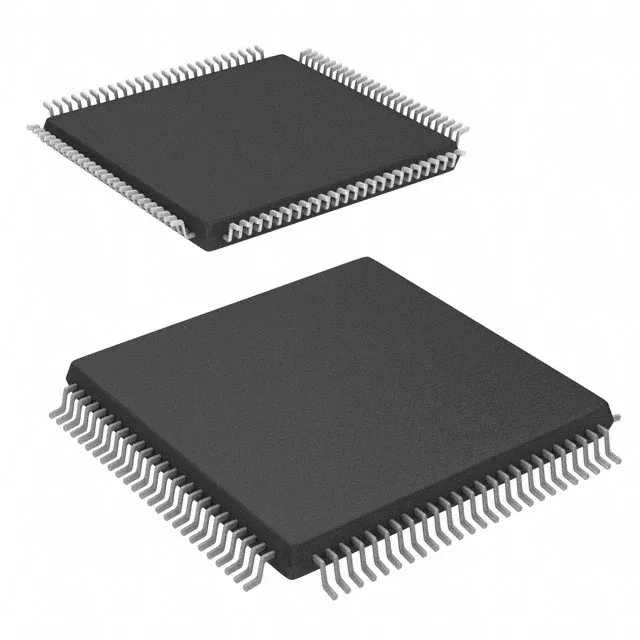
The 100-LQFP package maps to a 100-TQFP (14x14 mm) supplier device package. This is a 0.5 mm pitch fine-pitch QFP — a 4-layer PCB is recommended for fan-out of the address and data lines. The supply decoupling should place a 0.1 µF ceramic within 2 mm of each VDD/VSS pair; the dual-port architecture draws transient current on both ports simultaneously, so the bulk decoupling (10 µF tantalum or MLCC) per supply rail is non-negotiable.