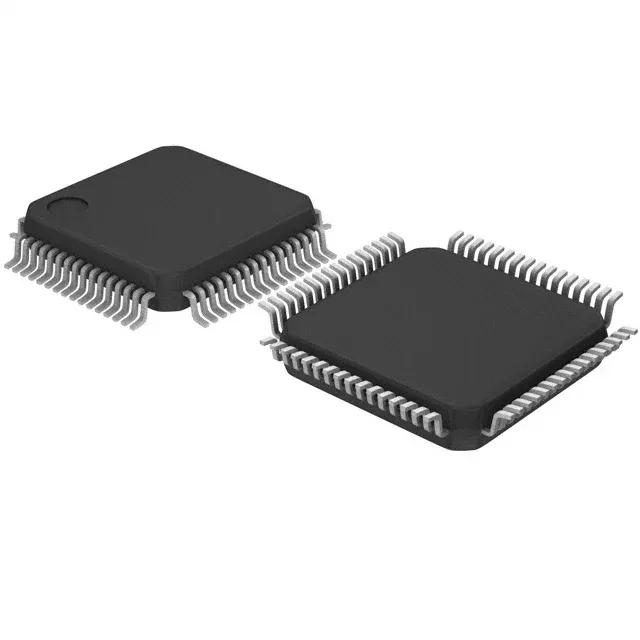
128 Kbit dual-port SRAM for shared-memory arbitration
This part is designed for applications requiring independent read/write access from two ports to a shared memory array, such as multiprocessor communication, FIFO buffering, and video frame buffers in telecom infrastructure and networking equipment.
25 ns access — timing closure in a shared-bus design
In a dual-port architecture, this defines the worst-case arbitration latency when both ports contend for the same memory location. A 25 ns part keeps cycle times tight enough for 40 MHz-class bus masters without wait states, but the designer must budget the port-to-port contention delay (typically a few ns beyond the access time) in the timing closure analysis. The write cycle time matches the read access at 25 ns, so back-to-back writes can sustain the same throughput.
The 64-LQFP footprint and 3.0V–3.6V supply range are common across the CY7C006 family, so a pin-compatible sibling from the same base product number (CY7C006) may be available through surplus or broker channels, but no drop-in replacement is formally documented.
Commercial temperature grade — indoor, controlled environments
If the design demands extended temperature, a different dual-port SRAM family with industrial temperature rating would be needed.