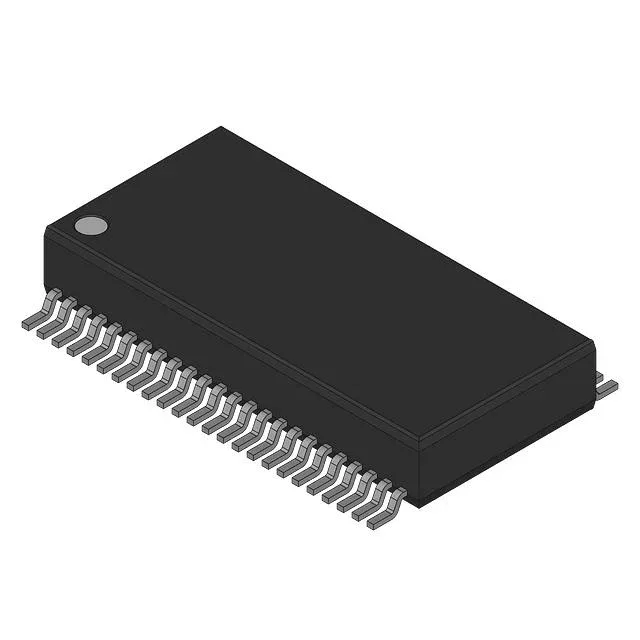
The CY28349BOC is a Cypress clock synthesizer and driver built around an integrated PLL. It accepts a single LVTTL or crystal input and distributes up to twenty clock outputs, making it a central clock-tree device for a motherboard, baseband card, or networking line card that needs to fan a clean reference to multiple PLLs, ASICs, or FPGAs. The 1:20 ratio means one reference oscillator feeds twenty loads — a significant fanout that saves multiple buffer stages but also places a premium on the PLL's jitter performance and the board's decoupling scheme. The supply is tightly specified at 3.135 V to 3.465 V, so the 3.3 V rail needs to stay inside ±5 % under transient load. Operating temperature is limited to 0 °C to 70 °C — a commercial-grade part intended for indoor, temperature-controlled equipment such as servers, telecom racks, and test gear.
Package and footprint — 48-BSSOP considerations
Housed in a 48-lead SSOP (7.50 mm body width), surface-mount only. The 0.635 mm pitch is fine enough that a standard wave-solder profile may bridge adjacent pins — reflow is the recommended assembly method. No exposed thermal pad, so the package relies on the leadframe and PCB copper for heat dissipation; keep the surrounding ground plane continuous under the part.
Active production, but RoHS non-compliant
That said, it is marked RoHS non-compliant, meaning it contains lead (Pb) in the solder finish or die-attach. This is a hard stop for any design that must meet EU RoHS or similar directives. For legacy assemblies that are RoHS-exempt or already use tin-lead solder, it is a valid, fully qualified drop-in.