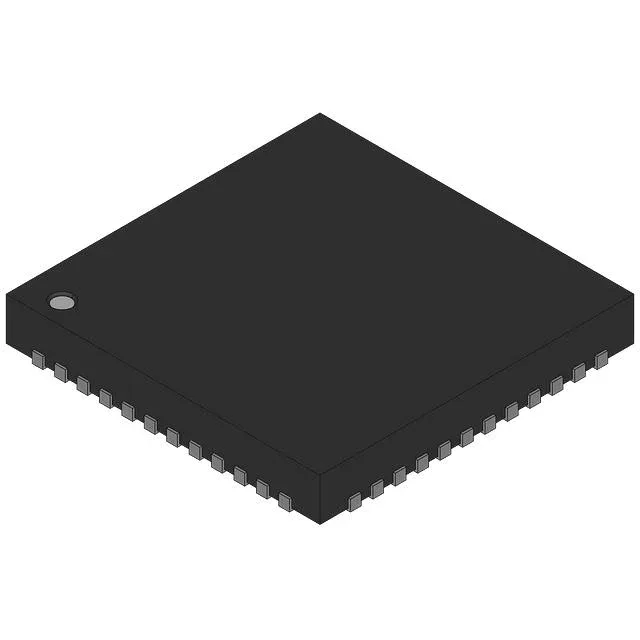
PLL-based clock driver for high-speed differential distribution
The Cypress CY23020LFI-3 is a PLL-based Zero Delay Buffer designed to regenerate and distribute a low-jitter LVPECL clock with deterministic phase alignment. It accepts one LVPECL input and fans it out to ten LVPECL outputs (2:10 ratio), all differential, all running up to 400 MHz. The part operates from a 3.135V to 3.465V supply and is specified over the industrial temperature range of -40°C to 85°C. It comes in a 48-VFQFN Exposed Pad package (48-QFN, 7x7 mm) for surface-mount assembly.
The 400 MHz maximum frequency covers most high-speed serial interfaces — Gigabit Ethernet, PCIe Gen 1/2 reference clocks, SONET/SDH, and FPGA transceiver reference clocks. The 2:10 ratio means one input drives five output banks of two differential pairs each; a single CY23020LFI-3 can feed ten LVPECL loads from one oscillator or synthesizer, reducing BOM count and board area versus discrete fanout trees. Because it is a PLL-based Zero Delay Buffer, the output edges are phase-aligned to the input — there is no cumulative skew across the fanout. This matters for parallel clock domains where setup/hold margins are tight.
Supply and temperature — design constraints
The supply range is 3.135V to 3.465V — a tight 3.3V ±5% window. The PLL's loop filter and VCO are sensitive to supply noise; a clean, well-decoupled 3.3V rail is required.
RoHS status — compliance check
The CY23020LFI-3 is marked RoHS non-compliant. This is a hard constraint for any BOM that must meet RoHS or similar environmental directives. If your design requires RoHS compliance, you will need to look at a different part number in the family or a lead-free alternative.