What this high-side switch handles — and where it fits
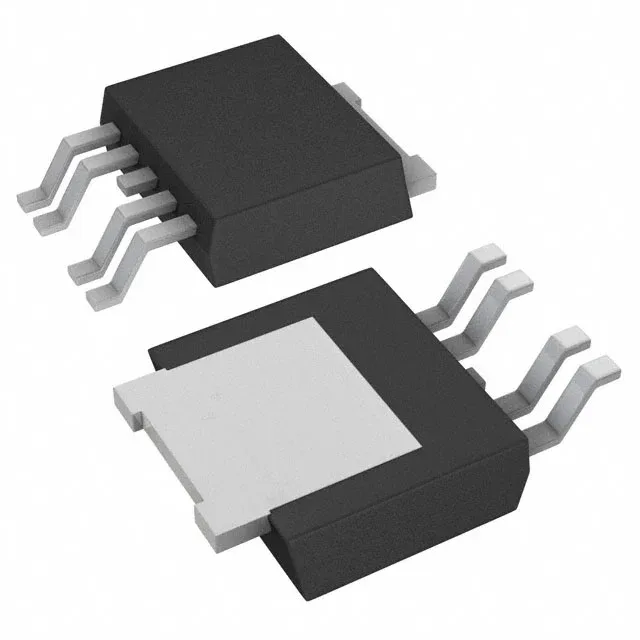
The BTS452RATMA1 is a single-channel high-side power switch from Infineon's miniPROFET® family, built for automotive and industrial loads that need a protected on/off switch with a status flag. It switches a resistive, inductive, or lamp load on the high side — the load connects between the output and ground, and the switch sits between the battery rail and the load. The 150 mOhm typical Rds(on) means at 1 A load current the voltage drop is about 150 mV, so the load sees nearly the full rail voltage. That on-resistance also sets the conduction loss: at 1.8 A max continuous output, the power dissipated in the switch is around 0.5 W, which the TO-252-5 package's exposed tab can sink to a board copper plane. The junction temperature rating of -40°C to 150°C confirms it can live under the hood or in an engine-bay environment where ambient heat plus self-heating push the die temperature.
Sizing the thermal budget for a 1.8 A load
The 150 mOhm typical Rds(on) is the key number for thermal design. At the 1.8 A maximum continuous output, the I²R loss is about 0.49 W. The TO-252-5 (DPak) package relies on the exposed tab soldered to a PCB copper area to get the heat out — without that plane, the junction temperature rises quickly above the 150°C limit. For a 0.5 W dissipation, a 1-inch-square copper pad on a standard 2-layer board keeps the junction below 125°C in a 85°C ambient. Compare that to the BTS142DATMA1, a low-side HITFET® switch with 23 mOhm Rds(on) and 4.6 A output — it handles higher current but switches the low side, so the load sees the full battery voltage only when the switch is on. The BTS452 is a high-side switch, which means the load is always referenced to ground — simpler wiring for many automotive loads like lamps, solenoids, and relays. Built-in fault protection includes current limiting (fixed), over-temperature shutdown, and over-voltage clamping. The auto-restart feature means after a fault clears, the switch tries to turn back on — useful for transient overloads like a lamp inrush without latching off permanently. The status flag output can feed a microcontroller input to log the fault.
The part is ROHS3 compliant.