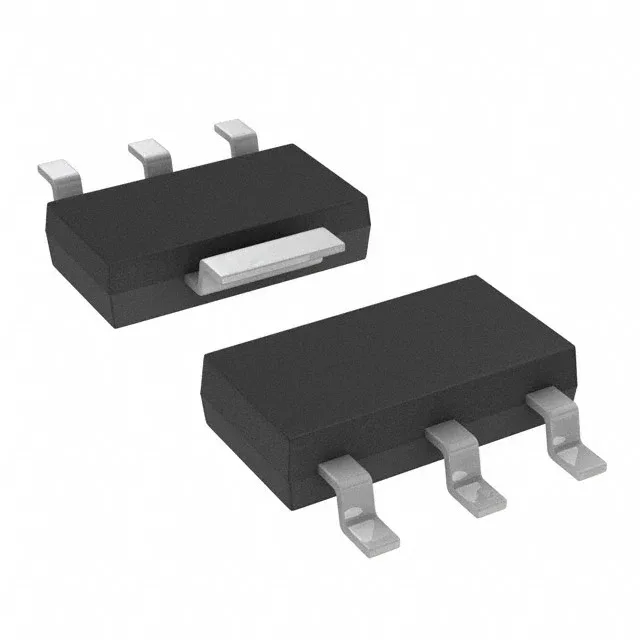
What a 600 V depletion-mode FET does that an enhancement-mode part cannot
Most MOSFETs you pick up are enhancement-mode — they stay off until you apply a positive gate voltage. The BSP135IXTSA1 is a depletion-mode N-channel device, which means it conducts with zero gate bias and requires a negative Vgs to pinch off the channel. That normally-on behaviour makes it the right part for a current-source bias, a cascode stage that must start conducting at power-up, or a linear regulator that needs to deliver current before the control loop wakes up. The 600 V drain-source rating (Vdss) in a SOT-223-4 surface-mount package is the other headline — you do not see many depletion-mode parts that can stand off that voltage in a small outline.
At the rated 120 mA, the conduction loss is about 650 mW (I²R), which fits inside the 1.8 W power dissipation limit at 25°C ambient, but leaves little headroom for elevated temperatures. Gate charge is only 3.7 nC at 5 V, so the gate drive energy per switching cycle is low — the driver does not need to sink much current to turn the device off. Input capacitance is 98 pF at 25 V drain-source, which keeps the switching losses modest even at moderate frequencies. The threshold voltage is 1 V maximum at 94 µA drain current, confirming the depletion-mode behaviour: the device is fully on at zero gate volts. The PG-SOT223-4 package has a large copper tab on the drain — the board copper area under that tab sets the effective thermal resistance, so the layout determines how close to the 1.8 W limit you can run.