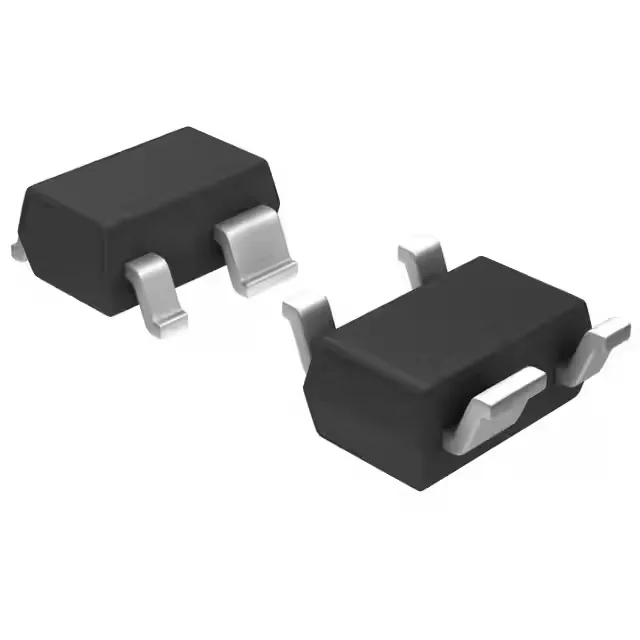
The Infineon BFP620H7764XTSA1 is a silicon-germanium (SiGe) NPN RF bipolar transistor designed for low-noise amplification in the microwave and millimeter-wave bands. It delivers 21.5 dB gain with a noise figure as low as 0.7 dB at 1.8 GHz, and its 65 GHz transition frequency pushes usable performance well into the 6 GHz to 40 GHz range — think 5G small-cell receivers, automotive radar front-ends, satellite downconverters, and high-speed optical-module driver stages. Operating junction temperature goes to 150 °C, which gives some headroom in compact RF modules where heat builds up around the PA stage.
Package and rework — SOT-343 reality
The BFP620H7764XTSA1 comes in the SC-82A / SOT-343 package (Infineon calls it PG-SOT343-3D). That's a four-pin, 2.0 mm × 2.1 mm body with a 1.3 mm pitch — small enough that hand-soldering with a fine-tip iron is possible but fussy. Hot-air rework at 300 °C with a 3 mm nozzle works fine; the part is MSL 1 per the RoHS3-compliant build, so no bake needed unless the bag has been open for months. The collector is on pins 1 and 4 (internally connected), base on pin 2, emitter on pin 3 — but the datasheet layout shows the recommended footprint with a grounded emitter pad. Keep the ground via close to the emitter pin to minimise emitter inductance; that's what kills gain at 6 GHz if you route it badly.
It is RoHS3 compliant. No second-source is listed by Infineon, but the BFP640FH6327XTSA1 (23 dB gain, 40 GHz fT) is a higher-performance sibling in the same package and pinout — it can serve as a drop-in upgrade if the design can tolerate the higher power dissipation (200 mW vs 185 mW).
The noise figure is specified as 0.7 dB to 1.3 dB across 1.8 GHz to 6 GHz. At 1.8 GHz the typical 0.7 dB puts this transistor in the same league as the BFP640 (0.65 dB) and well ahead of older parts like the BFR181 (0.9 dB at 900 MHz). The 21.5 dB gain at 1.8 GHz means a single stage can bring a -70 dBm signal up to -48.5 dBm before the mixer — enough to overcome the noise floor of most downconverter ICs. The 65 GHz fT also means the part has useful gain beyond 10 GHz, though the noise figure will rise above 6 GHz; the datasheet curve (not shown here) typically shows 2 dB at 10 GHz. For a 5G n77/n79 LNA (3.3–5 GHz), this part is a strong candidate.