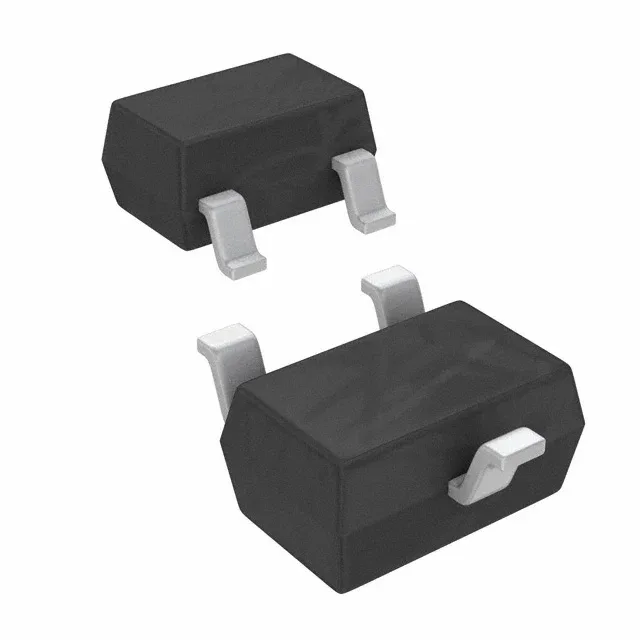
What this pre-biased PNP does and where it goes
It integrates two bias resistors — 10 kΩ in the base (R1) and 47 kΩ from emitter to base (R2) — so you can drive it directly from a logic output without external resistors. The collector-emitter breakdown is rated at 50 V, continuous collector current at 100 mA, and the transition frequency hits 200 MHz. This part is for switching and interface circuits where you want to reduce component count: digital outputs driving relays, LEDs, or small loads, or as a simple inverter. The pre-biased configuration saves board space and BOM line items in high-volume designs.
The BCR185WE6327BTSA1 is listed as Obsolete. That means Infineon no longer manufactures this exact variant. If you have an existing design that uses it, you are looking at a last-time-buy or surplus-channel procurement for any remaining production needs. For new designs, you will want to evaluate a pin-compatible pre-biased PNP from the same or another manufacturer — the SC-70 / SOT-323 footprint is common, and several vendors offer similar 10 kΩ / 47 kΩ resistor combinations.
Key ratings — the so-what for your circuit
The 50 V Vce breakdown gives you headroom on 24 V or 48 V industrial rails. The 100 mA continuous collector current covers small relays, indicator LEDs, and logic-level interface loads. Saturation voltage is specified at 300 mV with 500 µA base drive and 10 mA collector current — that keeps dissipation low in a small SOT-323 package. The 200 MHz transition frequency means it switches fast enough for most low-speed PWM and digital signaling up to a few megahertz. The built-in 10 kΩ base resistor and 47 kΩ emitter-base resistor set the bias point; you do not need to calculate external values, but you also cannot adjust them. That fixed ratio (R1/R2 ≈ 0.21) determines the turn-on threshold and the gain, so check that it matches your input voltage levels.