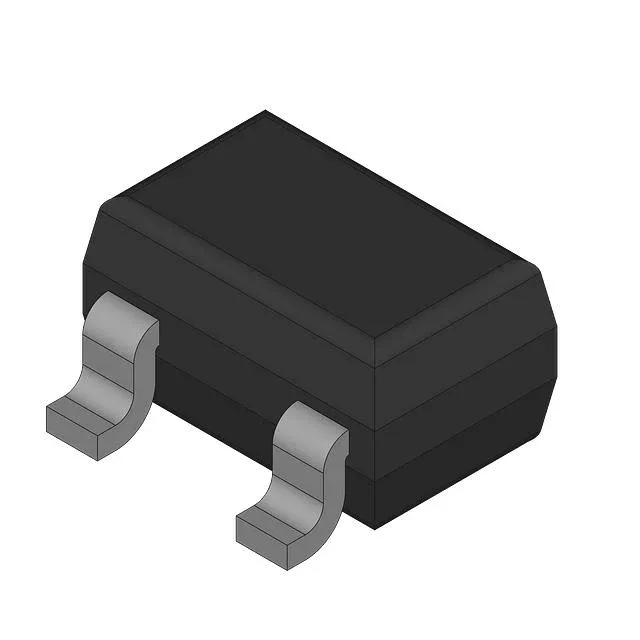
The BCR158WE6327 is a PNP pre-biased transistor from Infineon Technologies, qualified to AEC-Q101 for automotive applications. It integrates two bias resistors — 2.2 kΩ in the base leg (R1) and 47 kΩ from emitter to base (R2) — which eliminate the need for external resistor pairs in switching and driver circuits. Rated for 50 V collector-emitter breakdown and 100 mA continuous collector current, with a maximum power dissipation of 250 mW. The 200 MHz transition frequency keeps switching edges clean in low-speed gate drive and logic-level translation up to a few hundred kilohertz. Housed in the PG-SOT323-3-1 package (SC-70, SOT-323 footprint), it occupies about 2.0 × 2.1 mm on the board — a fit for space-constrained automotive modules like interior lighting controllers or seat-position sensors.
DC gain and saturation — what the numbers mean for the BOM
In a saturated switch, the base drive from the integrated 2.2 kΩ resistor must keep the transistor in hard saturation (Vce(sat) ≤ 300 mV at Ib = 500 µA, Ic = 10 mA) to minimise conduction loss. The 100 nA collector cutoff current (ICBO) at 25 °C is the leakage floor. At 85 °C ambient — typical under-hood — expect it to rise roughly an order of magnitude per 25 °C junction increase, so budget a few microamps of leakage in high-impedance pull-up paths.