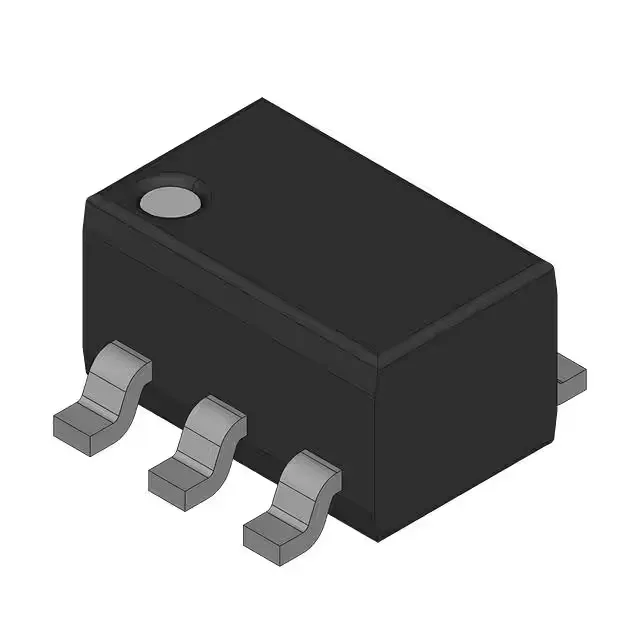
Automotive-grade dual transistor for load switching
The BCR141SE6327 packs two NPN pre-biased transistors in a single SOT-363 package, each with integrated 22 kΩ base and emitter resistors (R1 and R2). This eliminates two external resistor pairs per channel — a board-space saving on dense automotive ECU layouts. Qualified to AEC-Q101, the part operates across the full automotive temperature range without derating the 50 V collector-emitter breakdown or the 100 mA continuous collector current. The 250 mW total power budget splits across both die; at 85 °C ambient the junction stays inside the SOA for typical load-switching duty.
Bias network and switching performance
With matched 22 kΩ base and emitter resistors, the transistor turns on at a predictable input threshold — the base current is set by the external drive voltage minus two Vbe drops divided by 22 kΩ. The 130 MHz transition frequency means it handles PWM frequencies well above the automotive 20 kHz band without storage-time distortion. Minimum DC current gain is 50 at 5 mA, 5 V — sufficient to drive a 100 mA load with less than 2 mA base drive. The 300 mV saturation voltage at 10 mA keeps conduction losses low in the on-state. Collector cutoff current is max 100 nA (ICBO) — the pre-biased resistors pull the base to emitter in the off-state, so leakage stays below 100 nA even at 50 V on the collector. This matters for battery-connected modules where off-state current drains the vehicle's quiescent budget.
Package and sourcing posture
The PG-SOT363-6-1 (SC-88) package uses a 1.25 × 2.0 mm footprint with 0.65 mm lead pitch — standard for automotive sensor modules and body-control PCBs. Surface-mount assembly with no exposed pad simplifies the reflow profile and visual inspection.