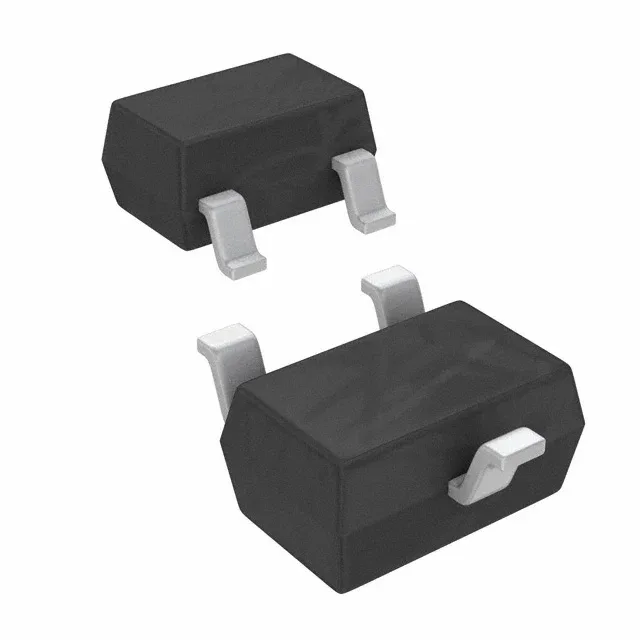
Infineon Technologies BCR112WE6327BTSA1 — Discrete Semiconductors

Infineon BCR112WE6327BTSA1 NPN Pre-Biased Transistor, 140MHz

MPNBCR112WE6327BTSA1
Obsolete

Infineon BCR112WE6327BTSA1 NPN pre-biased transistor, SC-70 SOT-323, 4.7 kOhms base and emitter resistors, 100 mA Ic, 50 V Vceo, 140 MHz transition frequency, 250 mW power dissipation.

$0.1900Ref. price · indicative, final on quote
StockContact for availability
MOQ1 pcs
  • 100% new & originalTraceable channels only — no refurbs, no pulls, no remarked parts.
  • Date & lot codes on quoteStated per line before you commit; label photos on request.
  • MSL-compliant ESD packingMoisture-sealed bags with indicator cards; reels photo-verified.
  • PayPal buyer protectionPay by T/T, PayPal or Payoneer — card payments covered end to end.

Specifications

BCR112WE6327BTSA1 Technical Specifications
ParameterValue
Mounting typeSurface Mount
FET typeNPN - Pre-Biased
Voltage - collector emitter breakdown50 V
Current - collector (Ic)100 mA
Current - collector cutoff100nA (ICBO)
DC current gain (hFE) (Min) @ ic, vce20 @ 5mA, 5V
Power - max250 mW
Frequency140 MHz
PackageTape & Reel (TR)
CaseSC-70, SOT-323
Resistor - base (R1)4.7 kOhms
Resistor - emitter base (R2)4.7 kOhms
Vce saturation (Max) @ ib, ic300mV @ 500µA, 10mA

Product details

The Infineon BCR112WE6327BTSA1 is an NPN pre-biased transistor — a digital transistor with a 4.7 kΩ base resistor (R1) and a 4.7 kΩ emitter-base resistor (R2) integrated into the same SC-70 SOT-323 package. This configuration eliminates the two external resistors normally needed for a saturated switch, saving board area and BOM line items in high-volume designs. With a collector current rating of 100 mA and a collector-emitter breakdown voltage of 50 V, it handles typical low-side switching loads like relay coils, LED strings, and logic-level interface circuits in consumer, industrial, and automotive modules.

Switching performance at low base drive

The Vce saturation is specified at 300 mV maximum with only 500 µA base current driving 10 mA collector current. The 140 MHz transition frequency confirms it can handle PWM frequencies well into the megahertz range, though practical switching speed in a saturated circuit will be lower due to storage time.

Infineon lists the BCR112WE6327BTSA1 as obsolete. No successor order code appears on the official record. If you have this on a BOM, you are looking at last-time-buy or surplus-channel sourcing. The SC-70 SOT-323 footprint is shared by many pre-biased NPN transistors from multiple manufacturers, but a drop-in replacement requires matching the 4.7 kΩ / 4.7 kΩ resistor divider, the pinout (base-collector-emitter in SOT-323), and the 100 mA / 50 V ratings. A direct cross to a DTC143 series part, for example, would need checking — DTC143 uses a different resistor ratio (4.7 kΩ / 4.7 kΩ in some variants, 10 kΩ / 10 kΩ in others).

Package and board-fit note

Surface-mount in SC-70 (also called SOT-323), supplier package designation PG-SOT323. The 250 mW power dissipation limit means you cannot pull 100 mA continuously at any significant Vce — derate for ambient temperature above 25 °C. For a 10 mA load at 300 mV saturation, dissipation is only 3 mW, well within the budget.

Frequently asked questions

Is BCR112WE6327BTSA1 obsolete?

Yes. Infineon lists the product status as Obsolete. Sourcing is through surplus or independent distribution channels.

What is the replacement for BCR112WE6327BTSA1?

No official replacement is listed by Infineon. A functional replacement must match the 4.7 kΩ base resistor, 4.7 kΩ emitter-base resistor, SC-70 SOT-323 footprint, 100 mA collector current, and 50 V breakdown. Check pin-compatible pre-biased NPN transistors from other manufacturers with the same resistor ratio — verify the pinout (base-collector-emitter) before committing the BOM.

What is BCR112WE6327BTSA1's power dissipation rating?

250 mW maximum. This is the total device dissipation; derate above 25 °C ambient. For typical saturated switching at low Vce, actual dissipation is much lower than the limit.