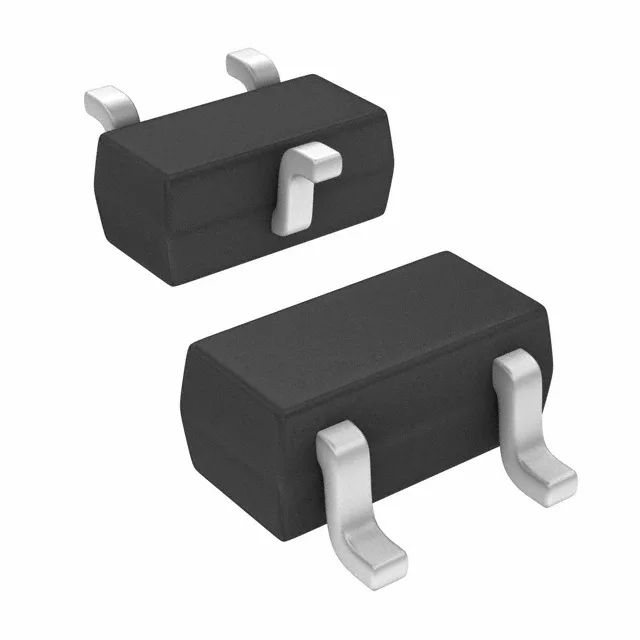
PNP pre-biased transistor in a tiny SC-75 footprint
The BCR 199T E6327: The Infineon BCR 199T is a PNP pre-biased transistor — the base resistor (47 kOhms R1) is integrated on-chip, saving one external component per switching node. The 200 MHz transition frequency supports moderate-speed switching, while the 50 V collector-emitter breakdown and 70 mA maximum collector current define the operating envelope for loads like small relays, LED indicators, or logic-level translation.
Ratings that define the fit
The 50 V VCEO rating means this part can handle 24 V and 48 V industrial rails with margin. The 70 mA continuous collector current is sized for driving small loads — think optocoupler LEDs, low-current relays, or signal-level MOSFET gates — not power stages. Saturation voltage is 300 mV at 500 µA base drive and 10 mA collector current, which keeps conduction losses low in the 5–10 mA range typical of logic-level switching. The integrated 47 kOhm base resistor sets the base drive — no external resistor needed, which simplifies the BOM and shrinks the layout.
Package and marking reality
The BCR 199T E6327 comes in a PG-SC75-3D package, a 3-pin plastic SC-75 (SOT-416). It is a surface-mount device supplied in Tape & Reel. The marking on the body is typically a two-character code — verify the top mark against the Infineon marking specification when incoming-inspecting a reel. The small body means hand-soldering is impractical; reflow or hot-air is the intended assembly method. No exposed thermal pad, so power dissipation is limited to the 250 mW package limit through the leads and board copper.
For a pre-biased transistor in a high-volume SC-75 package, the supply channel is mature — this is a standard catalog part, not a niche or allocation-sensitive line.