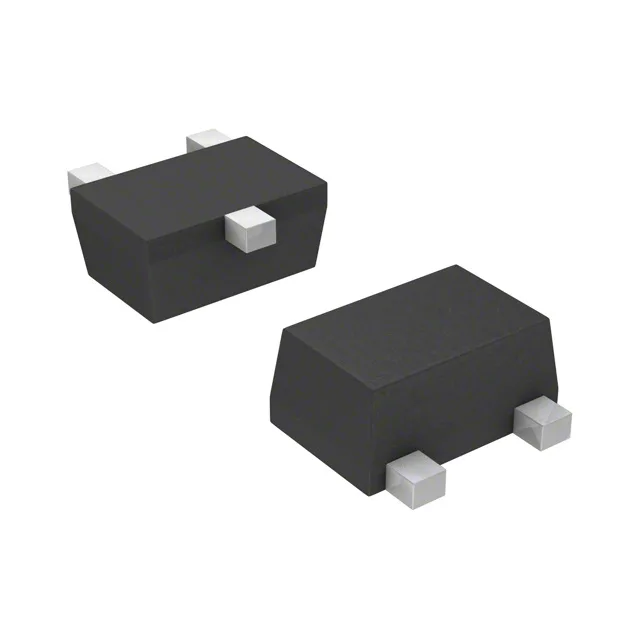
The base and emitter-base bias resistors are both 2.2 kOhms, which sets the turn-on threshold and limits base drive without external components.
The laser etch and date-code consistency matter here: a clean trace back to Infineon's own marking font and package plant is the baseline for accepting any lot. Because this is an obsolete PNP pre-biased transistor, there is no official Infineon successor listed for the BCR 153F E6327. Any replacement evaluation should start with the resistor values — 2.2 kOhms on both base and emitter-base — and the SOT-723 footprint. A same-function PNP pre-biased part from another manufacturer with matching R1/R2 and the same pinout is the practical cross-shop target.
Key ratings and the decisions they drive
This is a low-power device — 250 mW total dissipation in the SOT-723 package means it is suited for signal-level loads, not power switching. The 200 MHz transition frequency is high enough for basic switching up into the low-MHz range, but the pre-biased resistors will dominate the switching speed in practice. Vce saturation is 300 mV at 1 mA base and 20 mA collector — that is the on-state voltage drop when fully driven. The DC current gain minimum of 20 at 20 mA collector current, 5 V Vce, tells you the forced beta in saturation is low, which is typical for a pre-biased part where the resistor ratio sets the drive.