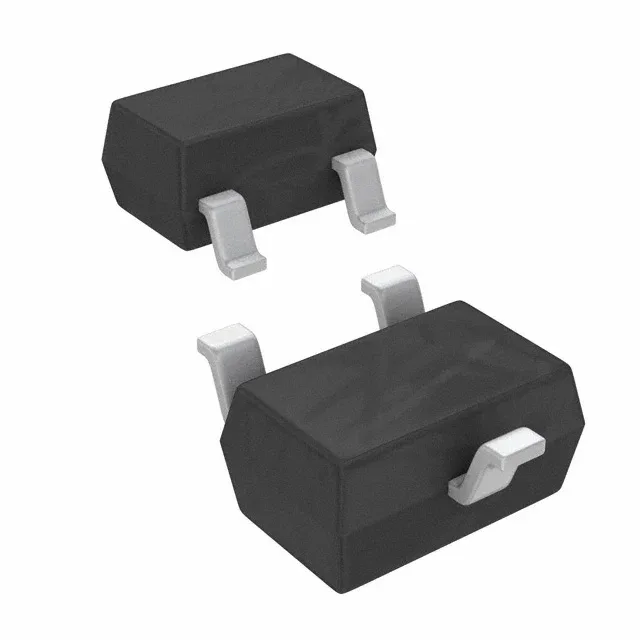
The Infineon BC 807-25W H6327 is a 45 V, 500 mA PNP epitaxial silicon transistor in a surface-mount SOT-323 (SC-70) package, rated for 250 mW total power dissipation. It targets low-power switching and amplification roles in consumer, industrial, and automotive auxiliary circuits — load drivers, signal inverters, and small-signal pre-drivers — where the 200 MHz transition frequency keeps switching edges clean up to moderate speeds.
This part is listed as obsolete by Infineon.
45 V / 500 mA — the ratings that decide fit
The 45 V collector-emitter breakdown and 500 mA continuous collector current set the operating window. The 500 mA ceiling means it handles relay coils, small solenoid valves, and LED strings up to about 300 mA continuous with derating for ambient temperature. Maximum saturation voltage is 700 mV at 50 mA base / 500 mA collector, so on-state dissipation at full load is roughly 350 mW — above the 250 mW package limit, meaning you must stay below 500 mA in practice unless pulse-width duty-cycling is in play.
hFE bin 25 — why the gain band matters
The "25" in the ordering code denotes the hFE bin: minimum DC current gain of 160 at 100 mA collector current and 1 V Vce. This is tighter than the standard BC807 (hFE min 100 at the same bias point), giving a narrower beta spread across reel-to-reel variation. For a design that relies on gain matching — differential pairs, current mirrors, or base-drive calculation in a Darlington stage — the 25 bin reduces the worst-case saturation margin you need to budget.
SOT-323 is a small three-lead package (approx 2.0 x 1.25 mm footprint). The 250 mW power limit is the absolute ceiling at 25°C ambient; above that, derate per the junction-to-ambient thermal resistance. MSL 1 out of the bag, no bake needed before reflow if the reel seal is intact.