Diode parametrics and switching performance
The BAT54E6327HTSA1: The 5 ns reverse recovery time suits it for fast-switching applications like polarity protection, freewheeling, and low-voltage rail clamping where the Schottky's low Vf reduces conduction loss compared to a standard PN junction. Junction capacitance is 10 pF at 1 V reverse bias and 1 MHz — low enough that switching losses in a 100 kHz boost converter are negligible, but worth checking if the diode sits across a high-impedance node where the capacitance couples switching edges into the bias rail. Reverse leakage is 2 µA at 25 V reverse — at the 30 V maximum rating the leakage rises with junction temperature, so a design running the diode near its thermal limit should budget the leakage current into the standby power calculation.
Package, footprint, and reflow considerations
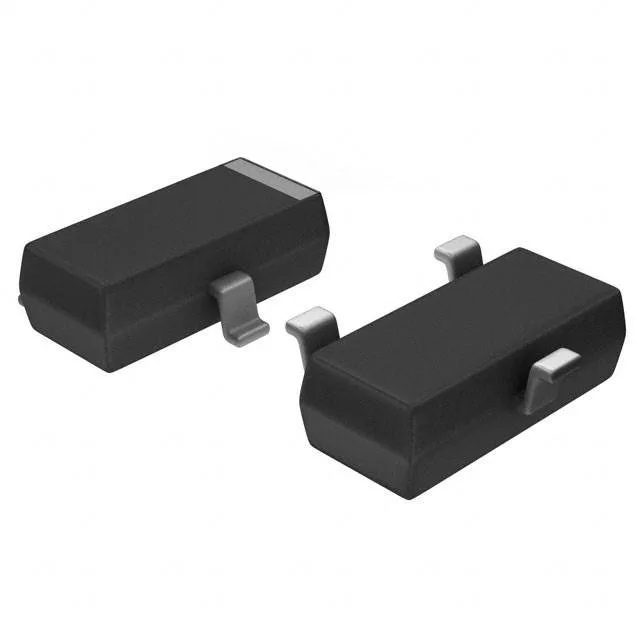
Housed in the standard SOT-23 package (TO-236-3, SC-59 equivalent), the PG-SOT23 supplier device package uses the same 3-lead footprint as the industry-common BAT54. The 0.95 mm pin pitch and 2.9 mm body length place cleanly on a standard 2-layer board without special fan-out — the cathode is pin 2, anode pin 1, and the third pin is a no-connect or tied to the cathode depending on the variant. Surface mount, supplied in Tape and Reel (TR) or Cut Tape (CT) options — the reel quantity suits automated pick-and-place; the cut tape works for prototype runs. No special MSL bake is required for the SOT-23 body, but the 150°C max junction temperature means the reflow peak should stay within the standard JEDEC profile for this package class.
Production status and compliance
The base product number is BAT54, a widely used Schottky family with multiple package and packing variants. The E6327 suffix identifies the tape-and-reel packing option; the HTSA1 suffix is the Infineon ordering code for the SOT-23 variant.