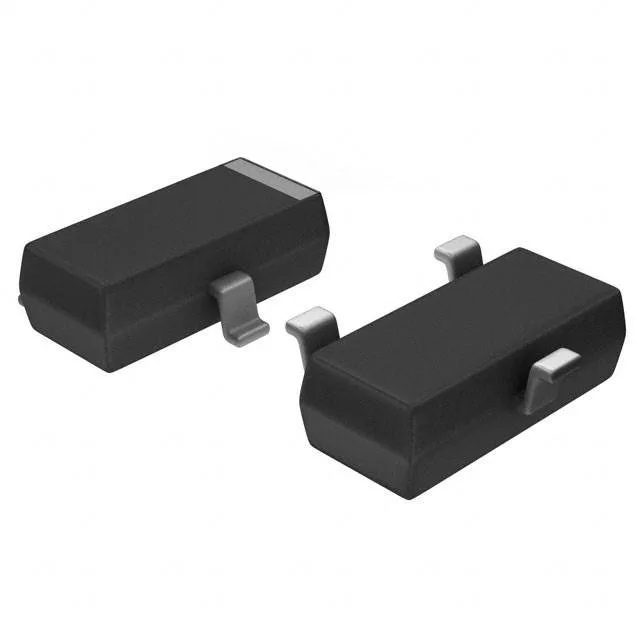
70 V / 70 mA Schottky in SOT-23 — bench-fit and rework note
The BAS70E6433HTMA1 is a 70 V, 70 mA Schottky barrier diode in the three-lead SOT-23 package (Infineon's PG-SOT23). The Schottky technology gives it a forward voltage of 1 V at 15 mA and a reverse recovery time of just 100 ps, which means it switches fast enough for high-frequency rectification and clamping without the stored-charge tail of a PN-junction diode. The 2 pF junction capacitance at 0 V bias keeps the AC loading light in RF detector or mixer circuits — that capacitance is the main thing that limits how high in frequency this part can go before the signal starts coupling through the junction.
SOT-23 rework and orientation
The SOT-23-3 footprint is about as rework-friendly as surface-mount gets. The cathode is marked by a band on the body; pin 1 is the anode, pin 2 is the cathode, pin 3 is the anode on the common-cathode variant (this is the single-diode version, so pins 1 and 3 are both anodes internally tied). The PG-SOT23 marking is Infineon's own designation for the standard SOT-23 package outline. No exposed pad means no thermal-via planning — the junction temperature rating of -55°C to 125°C is managed entirely through the leadframe and board copper. For continuous 70 mA operation, a basic 2-layer board with minimal copper keeps the die below 125°C.
Leakage and reverse bias at temperature
Reverse leakage is specified at 100 nA at 50 V reverse bias — that is the 25°C figure. Schottky leakage doubles roughly every 10°C, so at 85°C junction the leakage at 50 V will be around 1.6 µA. In a low-power battery circuit where the diode is blocking a 50 V rail, that leakage current becomes a standby-budget item. The 70 V reverse rating gives a 20 V margin above the 50 V test point, which covers most 48 V telecom rails and 24 V industrial supplies with healthy headroom. For a 12 V automotive rail, the margin is generous enough that reverse-voltage transients up to 40 V are still inside the safe operating area.
The base product number is BAS70, and this specific suffix (E6433HTMA1) denotes the tape-and-reel packaging with the standard SOT-23 lead finish.