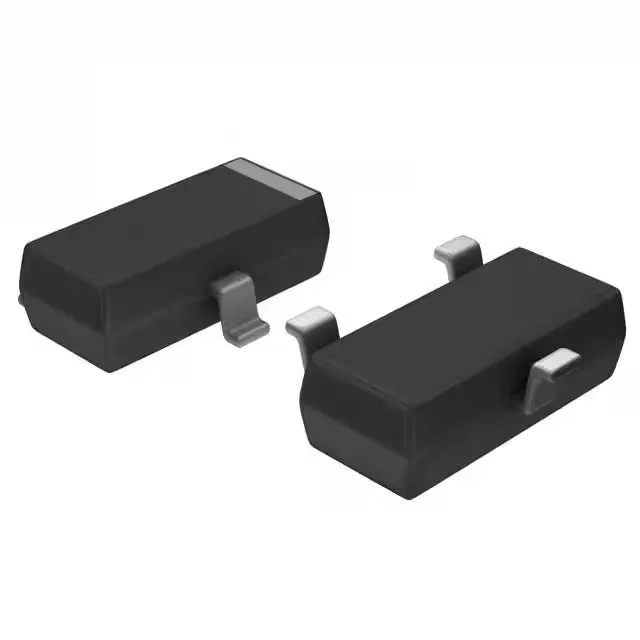
70 V reverse, 100 ps recovery — what the ratings mean for the circuit
The BAS7006E6433HTMA1: Rated for 70 V DC reverse (Vr max), this Schottky array blocks the full voltage on a 48 V bus or a 5 V rail with ample margin — the 70 V ceiling covers the ringing overshoot on a 48 V telecom supply without derating stress. Each diode in the pair handles 70 mA average rectified current (Io), which suits low-current signal rectification, OR-ing, and clamping in analog front-ends or small DC-DC feedback paths rather than power-stage duty. The 100 ps reverse recovery time (trr) is the headline switching-speed spec — at this recovery speed the diode contributes negligible stored-charge loss in a 1–10 MHz switching circuit, which keeps the junction temperature rise low and avoids the ringing that a slower recovery diode would inject into a high-impedance node. Forward drop is 1 V maximum at 15 mA — for a 70 mA load the Vf will be higher than the 15 mA test point, so the conduction loss per diode at full rated current is roughly 70–80 mW, which the SOT-23 package dissipates without issue in still air.
Common-anode pair in a SOT-23 footprint
The diode configuration is 1 Pair Common Anode — the two cathodes are independent, and the shared anode is the common pin. This pinout suits dual-rail OR-ing where the anodes tie to the same supply, or a clamp pair where both cathodes protect separate signal lines against a common overvoltage event. Housed in a SOT-23-3 (PG-SOT23) surface-mount package, the footprint matches the standard three-lead SOT-23 land pattern — no special pad geometry or thermal-via array is required for the 70 mA per-diode current.