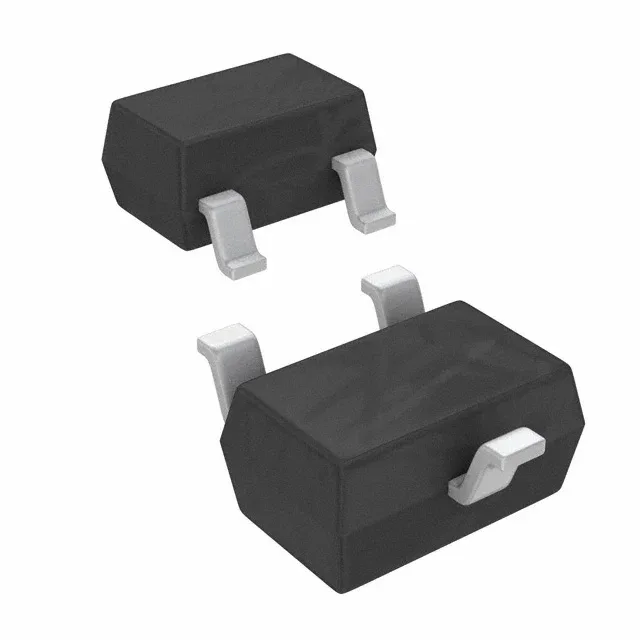
The Infineon BAS7005WE6327HTSA1 is a dual Schottky diode in a common-cathode configuration, packaged in a SC-70 (SOT-323) surface-mount case. The 100 ps reverse recovery time is the headline spec here — that sub-nanosecond switching speed makes this part suited for high-frequency rectification, clamping, and steering circuits where a standard pn-junction diode would leave too much stored charge in the loop.
Obsolete — sourcing through the independent channel
Sourcing now runs through the independent market — broker, surplus, and verified-new-old-stock inventory. No official successor part is listed on the Infineon product record for this exact order code.
100 ps trr — why it matters for the switching node
The 100 ps reverse recovery time is the parameter that separates this Schottky from a standard signal diode. In a 100 MHz or faster switching regulator snubber, or in an RF detector, the stored charge of a 1N4148 (typically 4 ns trr) would cause excess dissipation and ringing. The BAS7005W's 100 ps trr keeps the recovery event short enough that the diode essentially turns off before the next switching edge arrives. That said, the 70 mA per-diode current limit means this is a signal-level part, not a power rectifier — keep the average forward current under 70 mA per die and the peak within the pulse ratings.
Common-cathode pair — circuit topology fit
The 1 Pair Common Cathode configuration ties the cathodes of both Schottky diodes together on pin 3 (the center pin of the SC-70). This is the standard topology for a dual-series steering diode or a center-tapped rectifier in a voltage-doubler stage. The anodes are on pins 1 and 2. If your design calls for two independent Schottky diodes with separate cathodes, you would look at the BAS7004W (dual series) or two single BAS7002W devices instead.
Leakage and temperature — the 150 °C junction limit
Reverse leakage is specified at 100 nA maximum at 50 V reverse bias. At the full 70 V rating, expect leakage to rise, and it doubles roughly every 10 °C above 25 °C junction temperature. The maximum junction temperature is 150 °C, which is the usual Schottky ceiling — beyond that, leakage accelerates and the barrier degrades. For a 70 V rail with ambient temperatures above 85 °C, budget some headroom on the reverse voltage or derate the current to keep junction temperature under 125 °C.