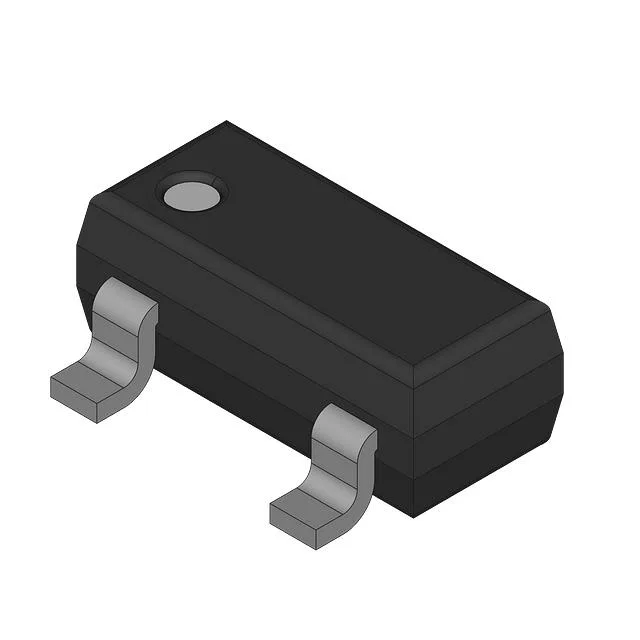
70 V common-anode Schottky pair — the automotive protection diode
Packaged in a SOT-23-3 footprint, it carries Automotive grade and AEC-Q101 qualification, which is the gate for any under-hood or cabin-electronics BOM that requires a qualified semiconductor. The 1 V forward drop at 15 mA is typical for a 70 V Schottky — the trade-off for the higher reverse voltage compared to 40 V Schottky pairs.
The 70 V reverse voltage rating is the headline spec that determines whether this diode survives load-dump and inductive-clamp events on a 12 V automotive bus. A standard 40 V Schottky would avalanche on a 60 V load-dump pulse; the 70 V rating gives enough headroom to clamp without exceeding the maximum rating, provided the surge energy stays within the device's single-pulse capability. The 100 nA reverse leakage at 50 V is the price you pay for that headroom — expect leakage to double or triple at 125 °C junction, but that is still acceptable for most protection and OR-ing applications.
Common-anode pair — which topology this fits
The 1 Pair Common Anode configuration means the two diode cathodes are separate (pins 1 and 3 on the SOT-23-3), and the anodes share a common pin (pin 2). This is the topology you reach for when you need to clamp two independent signal lines to the same positive rail, or when building a dual-series steering diode for overvoltage protection.
SOT-23-3 footprint and thermal reality
The 150 °C maximum junction temperature is typical for Schottky diodes, but the thermal resistance in a SOT-23 means derating above 70 mA average is necessary — the 70 mA rating is per diode, and the total package dissipation is the sum of both diodes' losses. For continuous current above 50 mA per channel, check the PCB copper area for heat sinking.
AEC-Q101 and Automotive grade — the qualification check
The BAS70-06B5000 is explicitly listed with Automotive grade and AEC-Q101 qualification. For a buyer filling an automotive BOM line, this qualification is the difference between a part that gets approved by the quality team and one that gets rejected at the gate review.