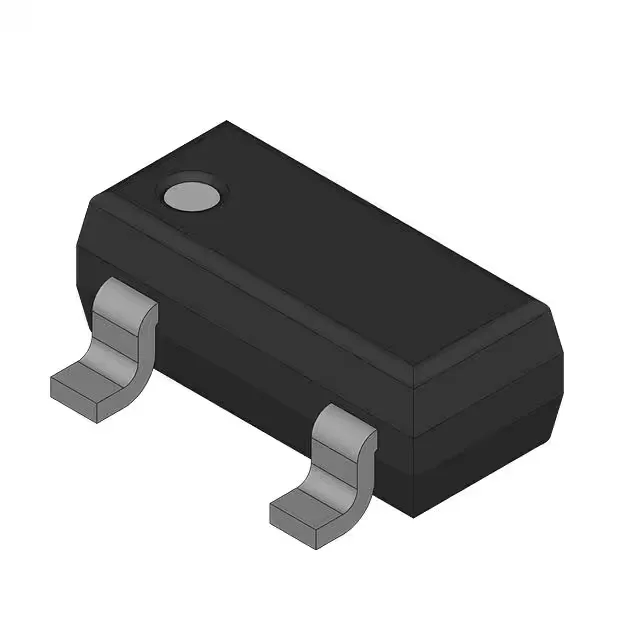
Infineon Technologies BAS70-05E6433 — Discrete Semiconductors

Infineon BAS70-05E6433 Schottky diode, 70V, 70mA, SOT-23

MPNBAS70-05E6433
Active

Infineon Technologies BAS70-05E6433 Schottky diode, dual common-cathode configuration, 70 V reverse voltage, 70 mA average rectified per diode, 100 ps reverse recovery time, PG-SOT23 surface-mount package.

$0.0800Ref. price · indicative, final on quote
Independent supplier — new & surplus stockAuthenticity-screened · ESD-safe packingListing updated Aug 2026

Specifications

BAS70-05E6433 specifications
ParameterValue
Diode typeSchottky
MountingSurface Mount
Voltage - DC reverse (Vr)70 V
Voltage - forward (Vf) (Max) @ if1 V @ 15 mA
Current - reverse leakage @ vr100 nA @ 50 V
Current - average rectified (Io) (per diode)70mA (DC)
Operating temperature - junction150°C
SpeedSmall Signal =< 200mA (Io), Any Speed
PackageBulk
CaseTO-236-3, SC-59, SOT-23-3
Diode configuration1 Pair Common Cathode
Reverse recovery time100 ps

Product details

70 V, 70 mA dual Schottky in SOT-23

The BAS70-05E6433: Packaged in the industry-standard PG-SOT23 (SOT-23-3) surface-mount footprint, the dual die shares a common cathode pin, with the two anodes brought out separately — a configuration used for dual-series steering, OR-ing, or protection networks where the cathodes tie to a common rail.

Forward drop and leakage profile

Forward voltage is 1 V maximum at 15 mA forward current — a moderate Vf for a 70 V Schottky, reflecting the trade-off between breakdown voltage and conduction loss. Reverse leakage is 100 nA maximum at 50 V reverse bias, which keeps standby dissipation low in battery-powered or high-impedance signal paths. Junction temperature rating of 150 °C allows the diode to operate in warm environments without derating the reverse voltage, though leakage current doubles with temperature and should be budgeted in high-ambient designs.

Frequently asked questions

What is the BAS70-05E6433's reverse recovery time?

The reverse recovery time (trr) is 100 ps, which qualifies it for high-speed switching circuits where fast turn-off is needed to minimize switching loss.