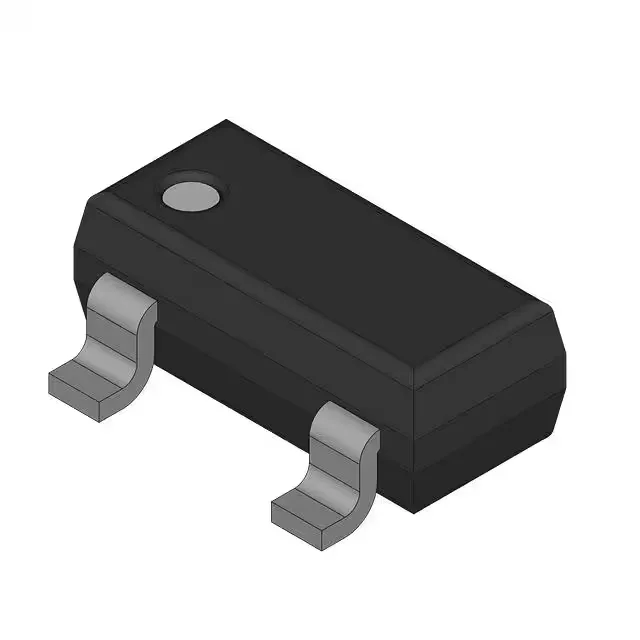
The 100 ps reverse recovery time is the headline: for a 70 V Schottky, that sub-nanosecond trr keeps switching losses negligible in 1–10 MHz rectifiers, flyback snubbers, or RF detector circuits. Forward drop maxes at 1 V at 15 mA, which is low enough for 3.3 V rail clamping without stealing signal headroom.
100 ps trr — the switching edge that matters for the signal-integrity budget
At 100 ps typical reverse recovery, this diode clears the stored charge faster than most 70 V Schottkies in a SOT-23. For a layout engineer, that means the ringing from diode turn-off in a 10 MHz boost converter or a high-speed comparator clamp will settle within one clock edge, not smear across several. The 100 nA reverse leakage at 50 V is the trade-off — typical for a Schottky this fast — so in a high-impedance node above 85 °C junction, budget the leakage shift. The 150 °C junction temperature rating gives thermal margin for ambient operation up to 125 °C if the power dissipation is kept under 200 mW or so.
Active lifecycle — no end-of-line clock ticking on this BOM line
Infineon lists the BAS70-04E6327 as Active. The PG-SOT23 package is a standard Infineon footprint shared across the BAS70 family, so second-source options from other vendors in the same SOT-23-3 pinout exist — but the official Infineon part is the one the datasheet guarantees.