Small-signal Schottky for rail clamping and fast switching
The BAS40E6433 is a 40 V, 120 mA Schottky diode in a standard SOT-23-3 surface-mount package. It is designed for low-voltage, high-speed switching applications where the Schottky's low forward drop and negligible reverse recovery time matter more than a higher current rating. Typical roles include reverse-polarity protection on low-current rails, flyback clamping across relay coils or small inductors, and signal-level rectification up into the VHF range.
The 40 V reverse voltage is the ceiling for the blocking voltage — keep the peak inverse voltage below that, and the diode stays off. The 120 mA average rectified current is the continuous forward current limit. That is a small-signal rating: it handles logic-level loads, sensor outputs, and gate-drive bootstrap circuits, but not a power supply output. If you need to switch a few hundred milliamps, this is the wrong part. The forward drop is 1 V maximum at 40 mA, which is typical for a Schottky of this die size — low enough to keep dissipation under control in a signal path, but not a sub-300 mV low-Vf Schottky.
100 ps reverse recovery — what that buys you
The 100 ps reverse recovery time is the Schottky's main advantage over a PN-junction diode. That means it can handle switching frequencies well into the MHz range without efficiency loss or ringing. If you are building a boost converter running at a few hundred kilohertz, or clamping the kickback from a fast-switching MOSFET half-bridge, the BAS40E6433 will not add a reverse-recovery tail that burns extra power or generates noise. The 5 pF junction capacitance at 0 V bias is low enough that it will not load a high-impedance node in an RF detector or a sample-and-hold front end.
SOT-23-3 footprint and sourcing reality
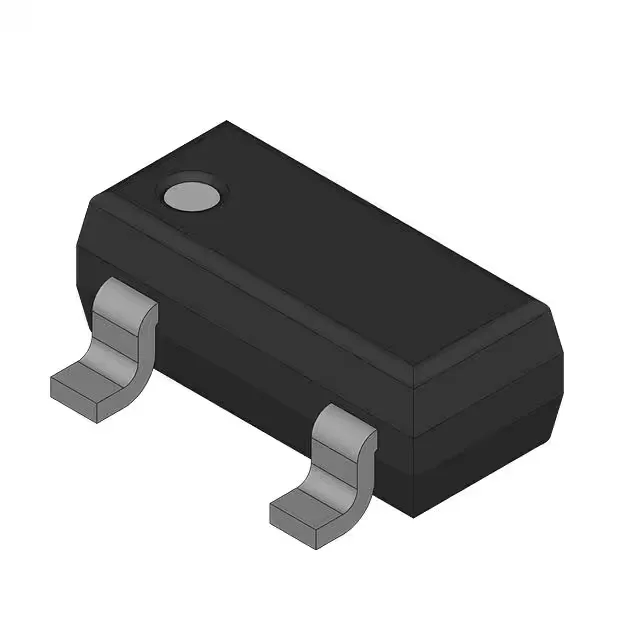
The BAS40E6433 comes in the industry-standard SOT-23-3 package (also known as TO-236-3 or SC-59).