What the headline ratings mean for a signal-level rectifier
The BAS4005WH6327XTSA1: Reverse leakage is 1 µA at the rated 30 V reverse bias — a figure that climbs with junction temperature, so in an 85°C ambient the leakage may double, but stays well within the budget for most signal-conditioning inputs.
100 ps reverse recovery — why it matters for high-frequency circuits
The 100 ps typical reverse recovery time is the key differentiator from a standard signal diode: it lets the diode switch off fast enough to handle MHz-range ringing, snubbing, or RF detection without introducing a stored-charge tail that would distort the waveform. For a flyback or inductive-load clamp at a few hundred kHz, the 100 ps trr means the diode essentially turns off before the voltage reverses — no hard-recovery spike, no extra EMI from the diode itself.
Common-cathode pair in SOT-323 — board-fit and routing
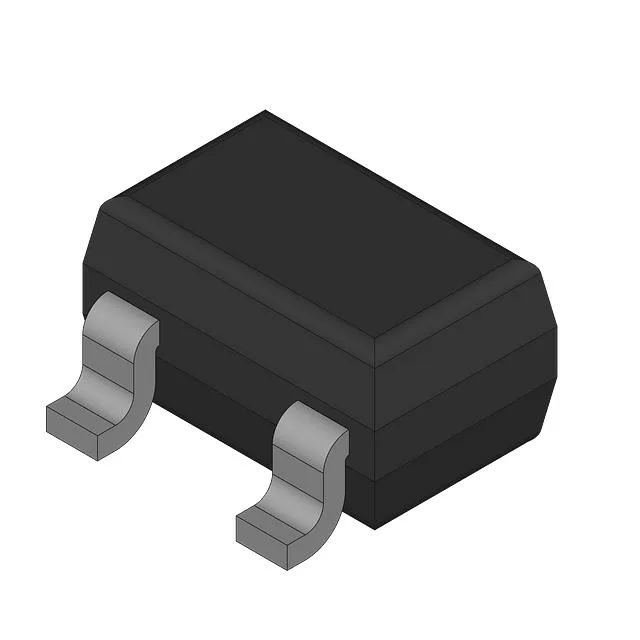
The two Schottky diodes share a common cathode (pin 2 on the SOT-323), so the pair can serve as a single full-wave rectifier centre-tap, a dual-series clamp, or a steering-diode array with only three PCB traces instead of four. The PG-SOT323 package occupies roughly 2.0 × 2.1 mm of board area — small enough to fit under a QFN or BGA periphery, but the 0.65 mm pitch demands a soldermask-defined pad and a 0.3 mm stencil aperture for repeatable solder-joint yield.
RoHS3 compliance and regulatory fit
Marked ROHS3 compliant, the BAS4005WH6327XTSA1 meets the EU Restriction of Hazardous Substances directive without exemptions — no lead, cadmium, or phthalates in the bill of materials.