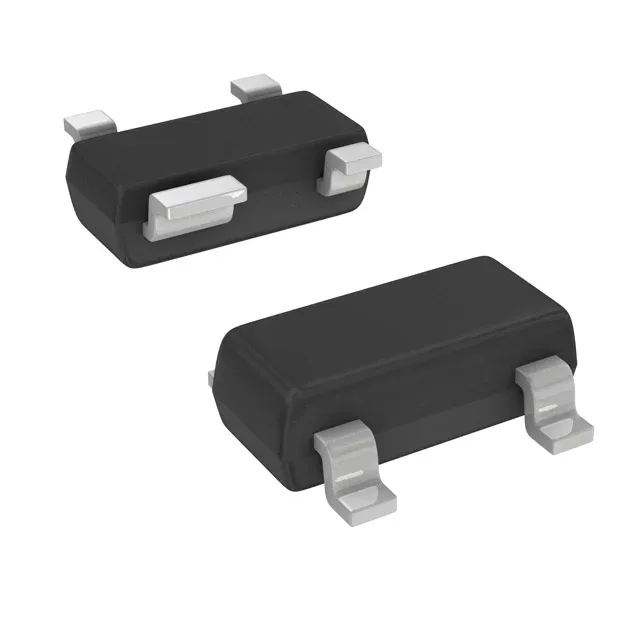
What the 40 V, 200 mA rating means on the bench
The BAS4002ARPPE6327HTSA1 is a single-phase Schottky bridge rectifier from Infineon, rated for 40 V peak reverse voltage and 200 mA average rectified current. The 790 mV forward drop at full load is typical for a Schottky at this current — conduction loss stays under 160 mW, so the SOT-143 package can dissipate it without a heatsink in still air. Reverse leakage is 10 µA at the 40 V rating. That figure climbs with junction temperature — at 125 °C expect it to be several times higher, which matters if the bridge sits in an engine bay or near a hot power supply.
Automotive qualification and package reality
AEC-Q101 qualified and listed with an Automotive grade, so this part is characterized and tested for the -40 °C to 150 °C junction temperature range typical of under-hood and chassis-mounted electronics. The qualification covers the reliability stress and PPAP documentation that automotive OEMs require. Infineon lists this as an Active product with ROHS3 compliance.
Where it fits in a power supply chain
As a single-phase bridge, it rectifies AC from a low-voltage transformer or secondary winding into a DC rail. The 40 V peak reverse rating leaves headroom for a 24 VAC nominal input — the rectified DC peaks near 34 V, well within the 40 V ceiling. The 200 mA average output suits auxiliary supplies, bias rails, or gate-drive power in automotive ECUs. The Schottky technology gives a lower forward drop than a standard silicon bridge at this current, which improves efficiency in a tight enclosure. No reverse recovery charge to manage — the turn-off is essentially instantaneous, so it won't inject switching noise into the DC bus.