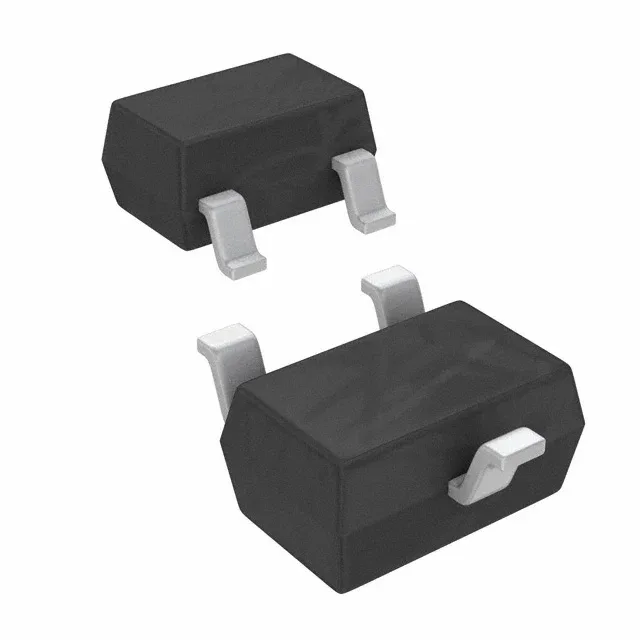
80 V, 250 mA signal diode with 4 ns recovery
The 2 pF capacitance at 0 V (measured at 1 MHz) keeps loading light on high-speed digital lines.
That means the manufacturer has announced end-of-life and is accepting final orders within a defined window. Once that window closes, the part will no longer be available through the factory channel. For a BOM line using this diode, the decision is immediate: place the last-time-buy quantity or qualify a replacement before supply tightens. The replacement path is either a pin-compatible sibling in the same BAS16 family — the BAS16WH6327 (without the XTSA1 suffix) is a natural candidate to evaluate — or a functionally equivalent fast-switching diode from another manufacturer in the SC-70 footprint. The 4 ns trr and 80 V / 250 mA envelope are common across multiple suppliers' signal diode lines, so a cross is feasible but requires bench validation of capacitance and leakage at the operating point.
SC-70 footprint and the 150 °C junction ceiling
The PG-SOT323 package (SC-70, SOT-323 variant) is a three-lead surface-mount package with a 1.3 mm body width. The 150 °C maximum junction temperature is the thermal limit — in a 85 °C ambient, the 250 mA forward current at 1.25 V forward drop (at 150 mA) produces about 190 mW dissipation, which keeps the junction rise within bounds with standard PCB copper. The 1 µA reverse leakage at 75 V is typical for a small-signal silicon diode at room temperature; leakage doubles roughly every 10 °C rise, so budget headroom if the junction runs hot.