4 ns reverse recovery — what it buys the signal path
The Infineon BAS16B5003 is a standard switching diode in the BAS16 family, built for fast signal-level switching rather than bulk rectification. The 80 V maximum reverse voltage and 250 mA average rectified current (Io) cover the typical range for low-power protection and switching roles in 3.3 V to 24 V DC circuits.
SOT-23-3 footprint — board-level fit
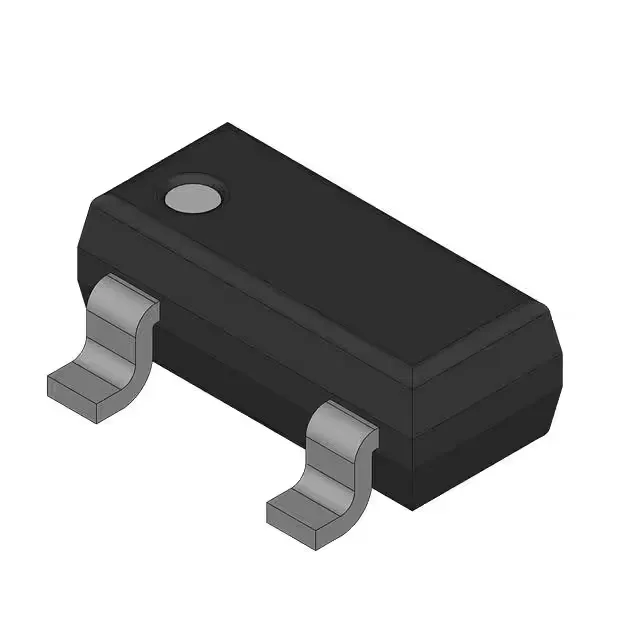
The BAS16B5003 ships in the standard SOT-23-3 package (Infineon's PG-SOT23-3-11 variant), with a 2.9 mm x 1.3 mm body and 0.95 mm pin pitch. That is the same footprint used by the vast majority of small-signal diodes and transistors, so it drops into existing pads without a layout change. The surface-mount package reflows well with standard lead-free profiles; the small thermal mass means it does not hold heat long under the hot-air station, so rework is straightforward if you keep the nozzle temperature around 350 °C and avoid dwelling past the solder solidification point.
The standard BAS16 series has been a catalog staple for decades, so the supply base is broad and the tooling is mature.
Forward voltage and leakage — the practical limits
The forward voltage (Vf) is specified at 1.25 V maximum when forward current is 150 mA. That is typical for a silicon switching diode in this current range — it means the voltage drop across the diode at moderate signal currents is about 0.7 V to 0.8 V at low mA and climbs to the 1.25 V ceiling near the rated current. Reverse leakage is 1 µA at 75 V reverse bias, which is low enough for most signal-level blocking and protection circuits; if your application holds the diode at high reverse voltage continuously, that leakage current contributes to the standing power dissipation, though at 75 µW it is negligible in all but the most power-sensitive battery circuits.