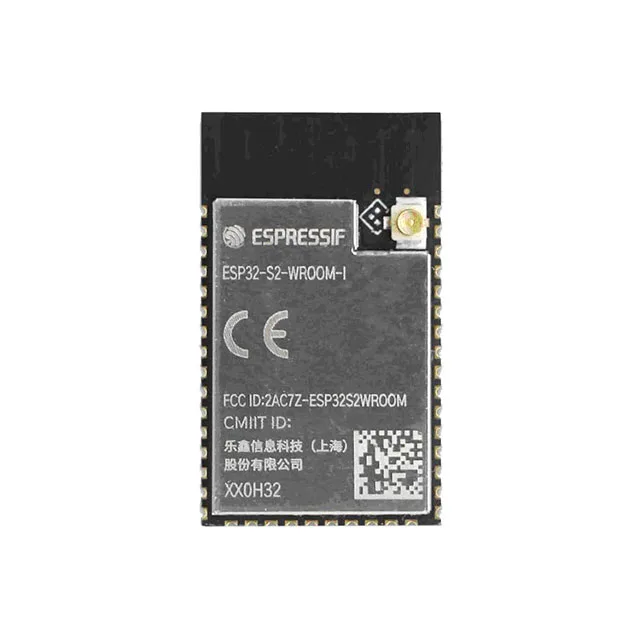
NRND — design-in migration path
The ESP32-S2-WROOM-I-N4 carries an NRND (Not Recommended for New Designs) lifecycle status from Espressif Systems. For a new BOM, the migration path is to the active ESP32-S3 family — pin-compatible in the same 56-VFQFN footprint, but with a different core architecture (Xtensa LX7 vs LX6) and expanded memory map. If you are already in production with the S2, the module is still orderable; just budget for a qualification cycle on the S3 when you spin the board.
WiFi link budget in the 2.4 GHz band
The module implements 802.11b/g/n at 2.4 GHz with a data rate ceiling of 150 Mbps (single-stream HT20). The transmitter delivers up to 19.5 dBm output power, and the receiver sensitivity floors at -97 dBm for the 1 Mbps DSSS mode — a link budget that closes a 20+ dB margin over the noise floor in a typical indoor AP-to-client path. The U.FL connector on this variant (the -I suffix) means the antenna is external; the board layout must route a 50-ohm controlled-impedance trace from the module pad to the U.FL launch, with a ground-plane cutout under the antenna element to avoid detuning.
Memory, temperature, and package
On-chip memory is 128 kB ROM plus 320 kB SRAM — enough for a lightweight RTOS and a TCP/IP stack, but tight for a full TLS handshake buffer.
Supply and interface rails
The receive current draws 63 mA to 68 mA, while transmit current ranges from 160 mA to 310 mA depending on the output power setting and data rate. The serial interfaces include ADC, I2C, I2S, SPI, PWM, and UART — enough for a sensor hub or a simple IoT gateway. The UART bootloader pins (GPIO0 and GPIO1) must be pulled to the correct state at power-up; a 10 kΩ pull-up on EN and a 0.1 µF decoupling cap within 5 mm of each VDD pin are the minimum layout requirements.