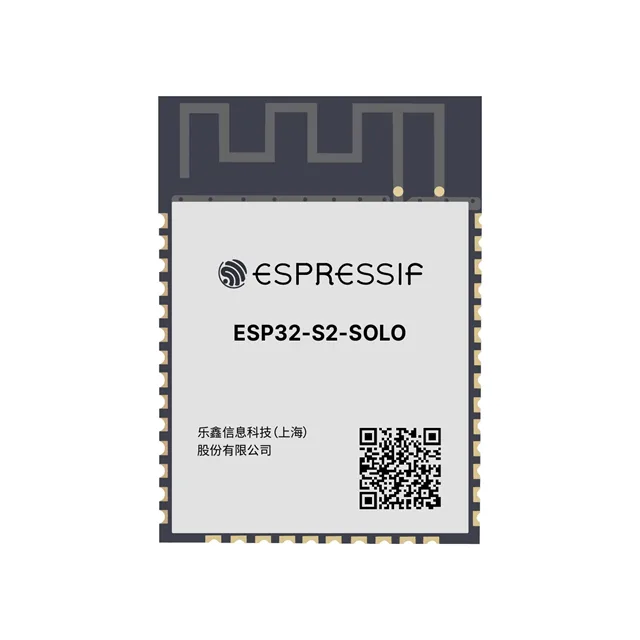
4 MB flash, PCB trace antenna — the BOM-fit decision
The ESP32-S2-SOLO-N4 packs a single-core Xtensa LX7 CPU with 4 MB flash and 336 kB SRAM — enough headroom for a TLS 1.3 stack and a small web server without external memory. The 128 kB ROM holds bootloader and crypto acceleration routines, so the flash is free for the application image. On the RF side, the integrated PCB trace antenna saves the cost of a ceramic chip or external whip, but the trade-off is placement sensitivity: the antenna pattern is printed on the module substrate, so metal enclosures or ground pours within 15 mm of the module edge will detune the match. Budget a pre-scan if the enclosure is shielded. Receiver sensitivity at -97 dBm (DSSS, 1 Mbps) gives a usable link margin of about 20 dB at 30 metres indoors through one drywall partition — enough for most IoT gateways. The 19.5 dBm TX power (802.11b, 1 Mbps) is the regulatory ceiling in most regions; plan for a 2-3 dB back-off if the device must pass FCC modular certification without a conducted measurement.
Industrial temp range and supply rail
Current draw peaks at 310 mA during 802.11b TX at 19.5 dBm — size the 3.3 V rail for at least 500 mA to cover the module plus any external sensors or pull-ups. Receive current is a steadier 71–75 mA, so the thermal load during continuous listening is low.
Active lifecycle — no last-time-buy pressure
No NRND flag, no EOL notice on file. This means the module is still in volume production and qualified for new designs — no need to stockpile or plan a last-time-buy. The base product number ESP32-S2 covers a family of modules; the -N4 suffix specifically denotes the 4 MB flash variant. If a BOM later needs more flash, the -N8 (8 MB) sibling is a drop-in footprint replacement, though the pinout and firmware image size differ. No single-source risk; the ESP32-S2 ecosystem has multiple module vendors (Espressif, third-party) using the same IC, but the -SOLO-N4 is the first-party Espressif module with full certification and support collateral.