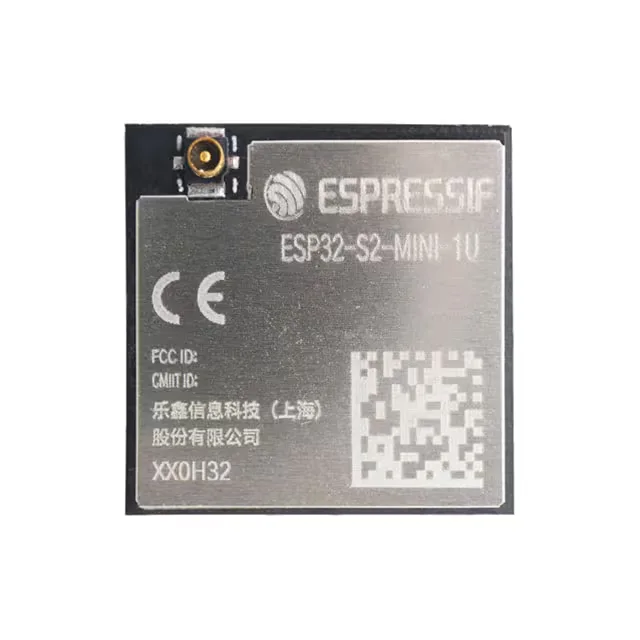
Module identity and wireless parametrics
The ESP32-S2-MINI-1U-N4 is a compact WiFi module from Espressif Systems, part of the ESP32 series, built around the ESP32-S2 core IC. It implements 802.11b/g/n at a data rate up to 150 Mbps in the 2.412 GHz to 2.484 GHz band. Transmit power reaches 19.5 dBm, and receiver sensitivity is -97 dBm, giving a link budget that supports reliable connections through walls and across typical indoor ranges. On-chip memory comprises 128 kB ROM and 320 kB SRAM, sufficient for lightweight TCP/IP stacks and application logic without external RAM in many IoT endpoints.
Supply, interfaces, and temperature grade
Supply voltage range is 3 V to 3.6 V, compatible with common 3.3 V rails. Current draw during reception is 63 mA to 68 mA; during transmission it ranges from 160 mA to 310 mA depending on output power setting. Serial interfaces include ADC, GPIO, I²C, I²S, SPI, PWM, UART, and USB, covering sensor readout, display driving, and peripheral control without a separate host MCU.
Housed in a 65-SMD module, the part is surface-mount and does not include an integrated antenna — the board layout must provide a suitable antenna trace or external antenna connector.