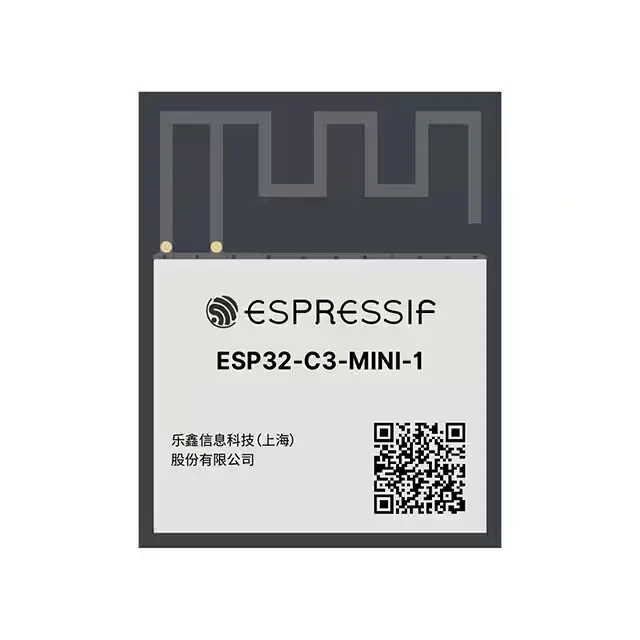
Espressif Systems ESP32-C3-MINI-1-H4 — RF & Wireless ICs

ESP32-C3-MINI-1-H4 WiFi/BLE Module – Active, -40°C to 105°C

MPNESP32-C3-MINI-1-H4
Active

Espressif Systems ESP32-C3 series, ESP32-C3-MINI-1-H4, 53-SMD module, WiFi 802.11b/g/n + Bluetooth v5.0, 150 Mbps PHY, PCB trace antenna, 4 MB flash, 384 kB ROM, 408 kB SRAM, 20.5 dBm TX power, -40°C to 105°C

$1.9500Ref. price · indicative, final on quote
Independent supplier — new & surplus stockAuthenticity-screened · ESD-safe packingListing updated Aug 2026

Specifications

ESP32-C3-MINI-1-H4 specifications
ParameterValue
SeriesESP32-C3
Antenna typePCB Trace
MountingSurface Mount
RF familyBluetooth, WiFi
Supply voltage3V ~ 3.6V
Current - receiving82mA ~ 84mA
Current - transmitting290mA ~ 350mA
Power - output20.5dBm
Frequency2.412GHz ~ 2.484GHz
Protocol802.11b/g/n, Bluetooth v5.0
Serial interfacesADC, GPIO, I²C, I²S, JTAG, PWM, SPI, UART, USB
Operating temperature-40°C~105°C(TA)
PackageTape & Reel (TR); Cut Tape (CT)
Data rate150Mbps
Memory size4MB Flash, 384kB ROM, 408kB SRAM
Sensitivity-104dBm
Case53-SMD Module
Utilized IC (Part)ESP32-C3FH4

Product details

Active production – no end-of-life notice

The ESP32-C3-MINI-1-H4: The ESP32-C3 series remains in volume production at Espressif, and the -H4 variant (with 4 MB embedded flash) is the current standard build. The module is listed under the ESP32-C3 series, which shares the same RISC-V single-core MCU architecture and pinout across the MINI-1 family. If a future BOM revision requires a different flash density, the -H1 (2 MB flash) variant is the same package and footprint.

Memory budget and firmware headroom

With 4 MB on-chip flash, 384 kB ROM, and 408 kB SRAM, the ESP32-C3-MINI-1-H4 can run a full WiFi stack and BLE 5.0 host simultaneously while leaving enough SRAM for a real-time application heap. The 408 kB SRAM is split between data and cache; typical firmware builds using the ESP-IDF v5.x SDK consume ~180 kB for the protocol stacks, leaving ~220 kB for application buffers and sensor fusion. The 20.5 dBm transmit power at the module antenna port is the conducted output; the PCB trace antenna adds ~2 dB of mismatch and board-dependent loss. For designs that need a regulated link budget exceeding +18 dBm EIRP, the module's RF pin can be routed to an external U.FL connector by selecting the -U variant — but the -H4 variant ships with the PCB antenna only.

The supply voltage range is 3.0 V to 3.6 V; the internal LDOs produce 3.3 V and 1.8 V rails. A 3.3 V rail with 500 mA peak capability is sufficient for the module plus a few external sensors — the module itself draws 82–84 mA in receive and 290–350 mA in transmit at 20.5 dBm.

Sourcing posture and ordering

For volume production, the TR option is standard; CT is suited for prototyping or small-run builds.

Frequently asked questions

Is ESP32-C3-MINI-1-H4 compatible with my existing ESP32-C3 design?

The -H4 variant uses the same ESP32-C3FH4 IC and same 53-pin module footprint as the other MINI-1 variants. The only difference is the embedded flash size — 4 MB here versus 2 MB on the -H1. If your firmware image fits within 2 MB, the -H1 is a drop-in alternative; if you need the full 4 MB, the -H4 is the correct choice.

What is the closest pin-compatible alternative to ESP32-C3-MINI-1-H4?

Within the same ESP32-C3 MINI-1 family, the ESP32-C3-MINI-1-H1 uses the same 53-SMD package and pinout but has 2 MB flash instead of 4 MB. Both are active and share the same RISC-V MCU core. If you need more flash (8 MB), the -H2 variant exists but is less widely stocked — confirm availability before a BOM swap.