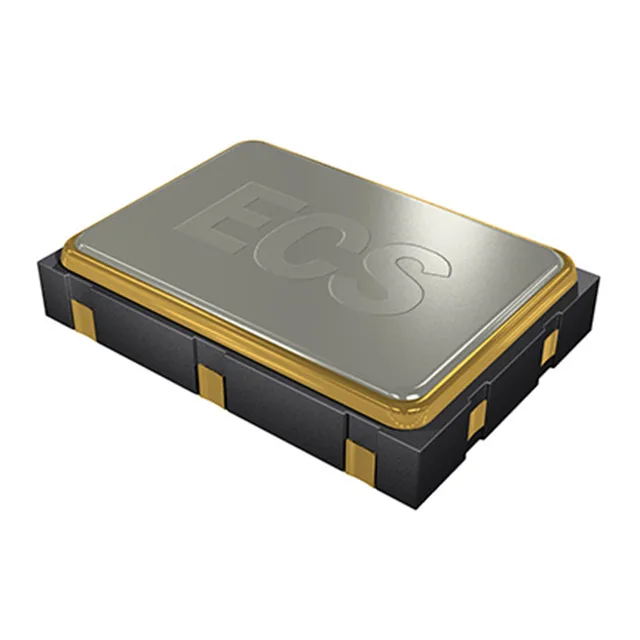
The ECS-2520S33-160-FN-TR: The ±10 ppm frequency stability covers the majority of industrial control and comms timing requirements without needing TCXO compensation.
Ratings that drive the selection decision
Frequency stability of ±10 ppm at 16 MHz sets the total frequency error budget — for a UART at 115,200 baud or a SPI running at 8 MHz, that drift sits comfortably inside the margin that the receiving PLL can track, so no additional clock correction is needed at the system level. Supply current draws 7 mA maximum when oscillating and drops to 10 µA when the enable/disable pin shuts the output off — the 3.5-order-of-magnitude standby current ratio makes this oscillator viable for power-cycled sensor nodes where the radio or MCU is off more than it is on. Industrial temperature grade -40 to 85 °C means the part operates inside equipment enclosures, at the factory floor, and in outdoor cabinets without derating. Junction temperature rise above ambient is negligible at 7 mA through a 3.3 V rail.
Package, footprint, and what the 4-SMD body means for layout
Because it is no-lead, the pad layout follows the datasheet footprint exactly; any solder-mask-defined pad opening variant changes the effective land area and shifts the solder joint stress profile under thermal cycling. A single 100 nF decoupling capacitor placed within 3 mm of the VDD pin handles the 7 mA switching transient from the HCMOS output stage. The enable/disable pin is a CMOS logic input — tie it high to run free or drive it from a GPIO to synchronously gate the output with the rest of the clock tree.
Active part — sourcing posture
The ECS-2520S33-160-FN-TR is listed as Active by ECS Inc. Confirm the full date-code and reel condition at quote time.