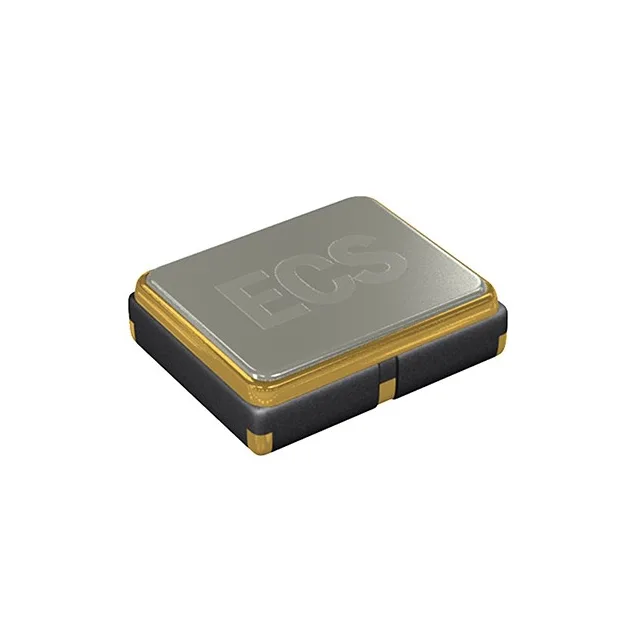
25 MHz HCMOS clock in a 2.5×2.0mm package
The ECS-2520MV-250-BL-TR: An Enable/Disable function ties the supply current down to a maximum of 10 µA when the output is shut off — for a battery-backed node that wakes periodically, leaving the oscillator enabled between cycles is not an option; the standby draw determines whether the backup cell lasts the intended shelf life.
±50ppm stability and the timing budget
At ±50ppm the part sits at the commercial-oscillator stability floor — adequate for USB/SDIO clock domains, UART baud-rate references, and general microcontroller clocks where the link or protocol tolerance absorbs the error budget. For a 25 MHz reference, ±50ppm means the actual output spans 24.99875 MHz to 25.00125 MHz — over temperature this stacks with the ±5ppm initial accuracy and the ±10°C drift across the -10°C to 70°C operating window, so a UART running at the nominal baud rate sees a worst-case error of roughly 125 ppm, still within the ±2% tolerance most 3% tolerance crystals tolerate. The commercial temperature grade caps this part at -10°C to 70°C — it is not the -40°C/+85°C industrial band and not the -55°C/+125°C military tier, so it belongs in office equipment, indoor instrumentation, and consumer-grade boards, not in engine-bay or outdoor-unheated enclosures.
Board footprint and tape-reel packaging
The 4-SMD no-lead (DFN-style) package exposes pads on the package bottom only — there are no side castellations or gull-wing leads, so the land pattern is a ground-plane-defined footprint on the PCB.