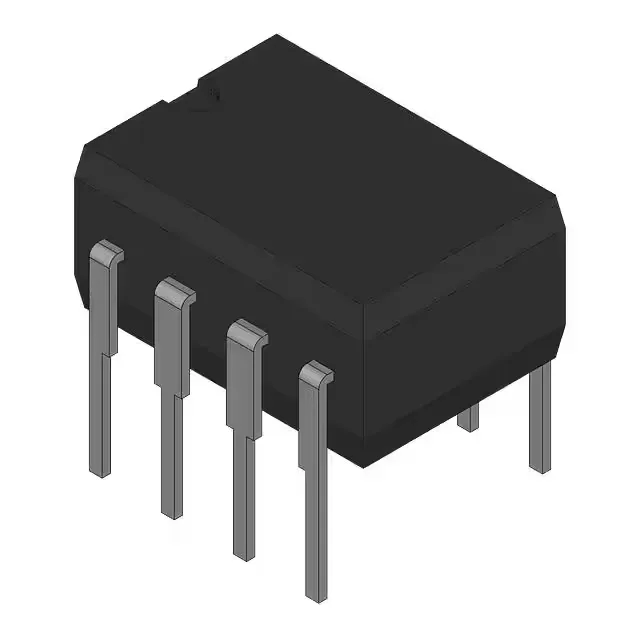
Dual general-purpose op-amp in a hermetic CERDIP
The OP297FZ is a dual-channel, general-purpose operational amplifier from Analog Devices, housed in an 8-lead CERDIP (0.300" body) for through-hole assembly. It is cataloged under the Memory category, but its function is a precision signal-conditioning amplifier. With a gain bandwidth product of 500 kHz and a slew rate of 0.15 V/µs, this part is suited for low-frequency sensor amplification, active filtering below 50 kHz, and general analog signal chains where the bandwidth ceiling is not the limiting factor. The dual-channel configuration in a single 8-pin package saves board space and reduces per-channel cost compared to two single op-amps, while the CERDIP hermetic seal provides a moisture barrier for long-term reliability in controlled environments.
Precision parametrics for the signal chain
Input offset voltage is trimmed to 50 µV typical, and input bias current is 35 pA typical — these figures place the OP297FZ in the precision category, adequate for strain-gauge bridges, thermocouple amplifiers, and photodiode front-ends where the offset error must stay below 0.1% of the full-scale signal. Supply current is 525 µA per amplifier (1.05 mA total for both channels), making it a moderate-power choice for multi-channel data-acquisition boards where the op-amp power budget is a secondary concern after the ADC and reference. The supply voltage range spans 4 V to 40 V single or dual supply — this wide compliance means the same op-amp can run from a single 5 V rail in a 5 V system or from ±15 V rails in a traditional analog bench supply, without re-spinning the BOM.
Package and temperature grade for deployment
The 8-CERDIP package (8-CDIP, 0.300" body width) is a ceramic dual-in-line with a hermetic seal — it withstands the standard soldering profile for through-hole boards and provides better moisture resistance than plastic DIP, though the part is RoHS non-compliant (lead-bearing solder terminations). Rated for -40°C to +85°C operating temperature, the OP297FZ covers the industrial temperature range — suitable for factory-floor instrumentation, test equipment, and environmental monitoring enclosures that see seasonal swings but not engine-bay heat. The through-hole mounting (Mounting Type: Through Hole) requires drilled PCB holes and wave or hand soldering — no reflow profile needed, but the assembly step adds cost compared to a surface-mount equivalent in an SOIC or MSOP package.
Active lifecycle and sourcing posture
The part is RoHS non-compliant (lead-bearing terminations), which restricts its use in markets with strict RoHS exemptions — buyers targeting EU or California markets should verify the exemption status for their product category before committing the BOM line.