Dual 200 mA / 150 mA rails with 60 dB PSRR
The MAX8530ETTKO: Two LDOs in one 3x3 mm package: one rated 200 mA, the other 150 mA, with fixed outputs of 2.8 V and 2.6 V respectively. That means a single IC powers two separate voltage domains — say a 2.8 V analog front-end and a 2.6 V digital core — without needing a second regulator on the board. PSRR is 60 dB at 100 Hz, which attenuates 120 Hz ripple from a mains-derived supply by a factor of 1000. If the input comes from a switching pre-regulator, the 60 dB figure drops at higher frequencies — the datasheet's PSRR-vs-frequency curve tells you where the crossover lands for your switching noise. Dropout is 200 mV max at 100 mA load — the headroom between the input rail and the 2.8 V output needs to stay above that margin across load and temperature. For a 3.3 V input feeding the 2.8 V rail, that leaves 300 mV of headroom; plenty for steady-state but tight under transient dips.
Industrial temp range and protection set
The Enable and Reset control pins let a supervisor sequence the two rails on and off in the right order. Built-in over-current, over-temperature, and short-circuit protection mean the regulator shuts itself down before the die reaches destructive temperature. On a repair bench, a dead rail that measures a short to ground on the output pin often points to a latched-off LDO — cycling the input power or the Enable pin resets it.
6-WDFN exposed-pad package — board integration
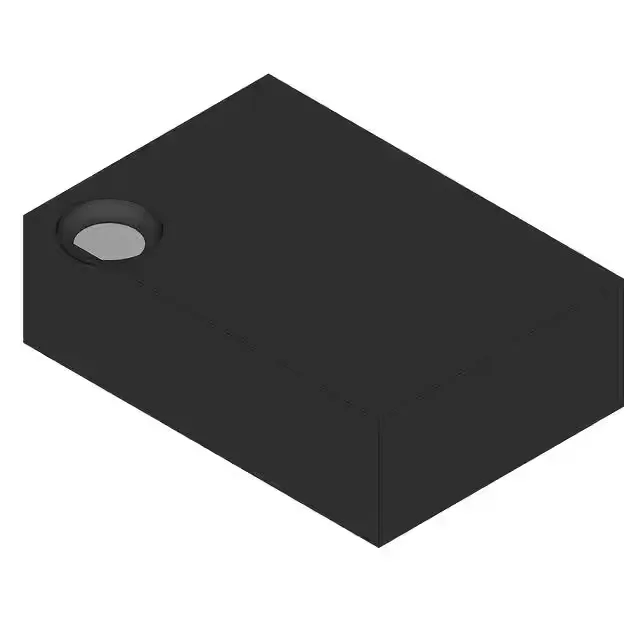
Housed in a 6-WDFN with exposed pad (3x3 mm body, supplier device package 6-TDFN-EP). The thermal pad on the underside must be soldered to a PCB copper plane to carry the heat away — without it, the junction temperature rises faster than the 85°C ambient limit allows, especially when both outputs are loaded near their maximum. The quiescent current is 220 µA typical — the LDO's own draw is low enough for battery-powered gear that spends most of its time in a light-load state, but not as low as the 1-2 µA Iq parts designed for always-on domains.