Dual-rail LDO for tight headroom and clean rails
The MAX8530EBTJO-T is a dual-output linear regulator from Analog Devices delivering a fixed 2.85 V at 200 mA and a fixed 2.6 V at 150 mA from a single input up to 6.5 V. The two rails are independent, so one can power a core or analog supply while the other feeds I/O or auxiliary logic — no external divider resistors needed since both outputs are factory-set. That tight dropout suits battery-powered designs where the supply sags near end-of-life, but it also means the pre-regulator or battery voltage needs to be chosen with headroom in mind.
PSRR and noise rejection in the audio band
The 60 dB PSRR at 100 Hz is the spec that matters when the upstream supply carries line-frequency ripple — from a mains rectifier or a switching converter running at 100/120 Hz. That 60 dB of rejection knocks a 100 mV ripple down to 100 µV at the output, which is quiet enough for an audio codec or a sensitive ADC reference. Above 100 kHz the PSRR rolls off, so a low-ESR input cap is still needed to shunt high-frequency noise before the LDO.
Package reality: 6-UCSP with no leads
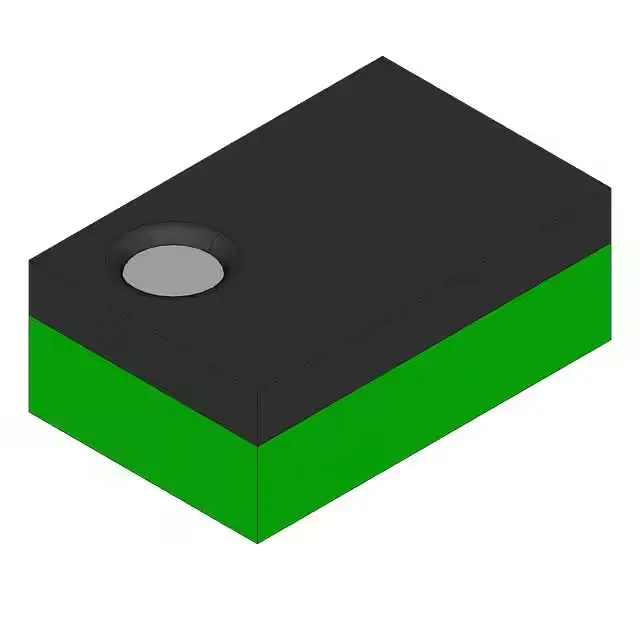
The 6-UCSP (1.57 x 1.05 mm) is a wafer-level chip-scale package — the solder balls are the only electrical and mechanical connection. There are no molded leads to absorb board flex, so the PCB must match the package's CTE and the assembly process should include underfill if the board sees thermal cycling or vibration. The 0.5 mm ball pitch demands a fine-line PCB; a two-layer board can route it if the fan-out vias are placed between balls, but a four-layer stack-up is safer for signal integrity.
Protection and quiescent draw
Built-in over-current, over-temperature, and short-circuit protection cover the common fault modes without an external supervisor — the LDO folds back current on a hard short and shuts down if the die temperature exceeds the limit. Quiescent current is 220 µA typical, which is moderate for a dual LDO; it is not ultra-low-power but acceptable for always-on blocks in portable instruments or battery-backed memory rails. The enable and reset control features let a system sequencer turn each rail on independently and monitor the output status — useful in multi-rail power-up schemes where the core must stabilise before the I/O rail comes up.